Weatherproof Canopy for Eucharistic Processions


Eucharistic processions bring the presence of Christ to the public. We want to have them regardless of weather, but most procession canopies are not made of fabric suitable for use if raining. What is the right form of a weatherproof canopy for Eucharistic processions? It should look liturgical and indicate the meaning of the procession. For it to be used even in rain, it should be waterproof. It also needs to be lightweight, rugged, and disassemblable for transportation. The dimensions should accommodate a priest holding the monstrance.

First, here is a typical canopy design (read more about them here).

Second, here is our weatherproof design. In place of the typical ornate style, we chose to use a simple set of symbols (Chi-Rho, Alpha-Omega) which are some of the oldest Christian symbols, to visually communicate the meaning of the procession at a distance. Other visual or graphical styles are possible within the weatherproof form.

In this post, we describe the design, fabrication, and usage instructions of the canopy so that it can be used as a basis for future work. These canopies successfully shielded the priest from rain in processions and withstood collision with many branches on urban streets and sidewalks.

Design

We chose a triangular prism or “tent” style so that rain would flow off the sides. There are three major components of the canopy: the frame (interior structure), the cover, and the poles.

Major Dimensions and Materials

The frame is 53.5″ wide, 71.5” long, and 24” tall. The poles are 7’ long and 1.75” in diameter. The length of the cover is 72” to give some tolerance for fitting it over the frame. The cover extends past the bottom of the frame by about 14.5” on each of the four sides.

The poles are 7’ long in total. Based on availability of wooden dowels at the requested 1.75” diameter, I chose to use 4’ and 3’ poles combined with a dowel screw. The color and exterior pattern of the wood was not consistent between the dowels, so I tried to match the color of the 3’ and 4’ members of each pole from the set I ordered. The dowels could have been painted or stained for better visual consistency. I considered adding finials at the ends of the poles but couldn’t find suitable ones within the timeline for the project.

The poles are connected to the frame by an eye screw on each side and a double-sided clip. The clip was about 3” long. The clip allows the poles to move with some freedom relative to the frame, which helps in not requiring the bearers to be in perfect synchronization as they walk.

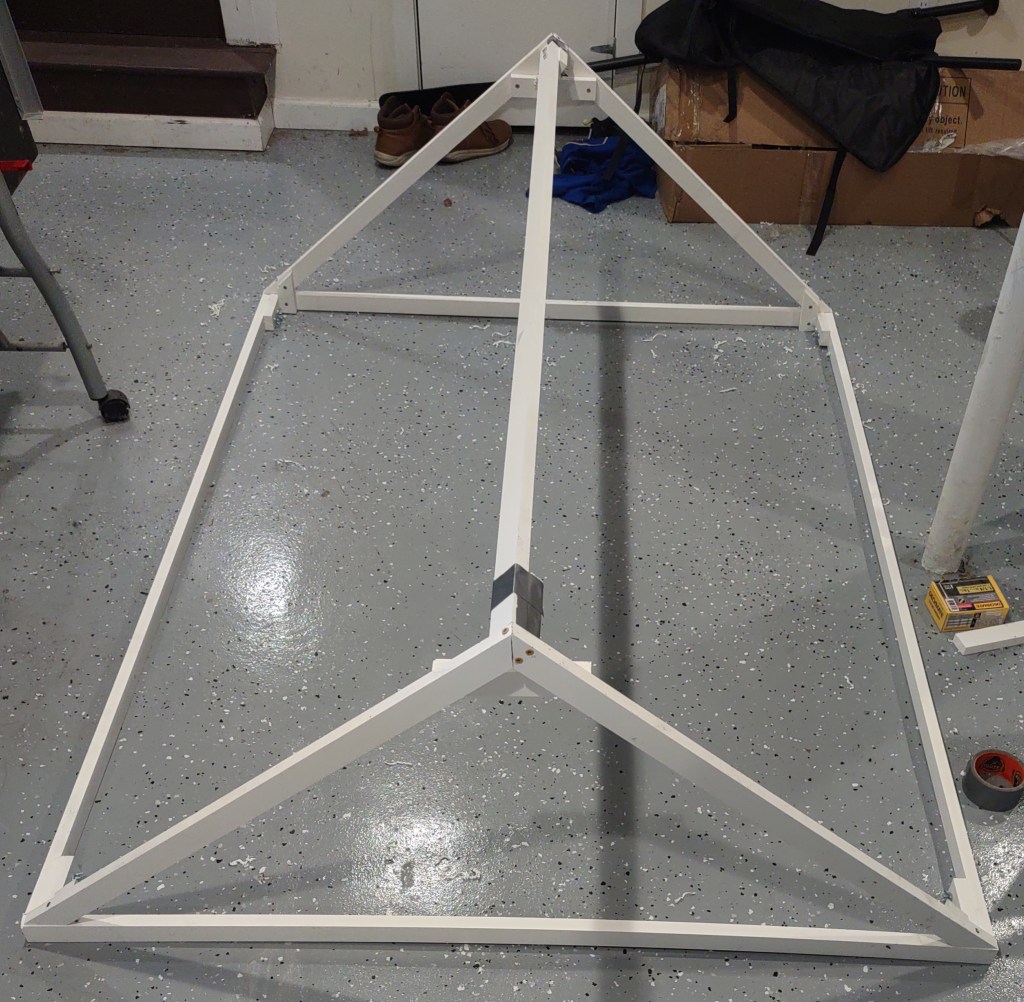
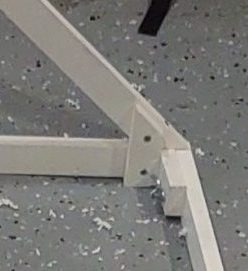
The frame consists of two triangles at the front and back and three length members. The triangles each have three junctions for the length members that are perpendicular to the triangle. On each junction, there are two bolt holes. To connect the length members to the junctions, the bolts are inserted into the holes and wing nuts are used to fasten them together. Wing nuts allow for hand-tightening and so are preferred over alternatives that would have required special tools. Between the first and second iterations of the design, braces were added between the perpendicular section of the junction and the triangles for strength.

For the cover, I chose Marine Vinyl. It is naturally waterproof and fairly durable, while not being too heavy. Boat cushions use marine vinyl. Vinyl is easy to cut and glue together.

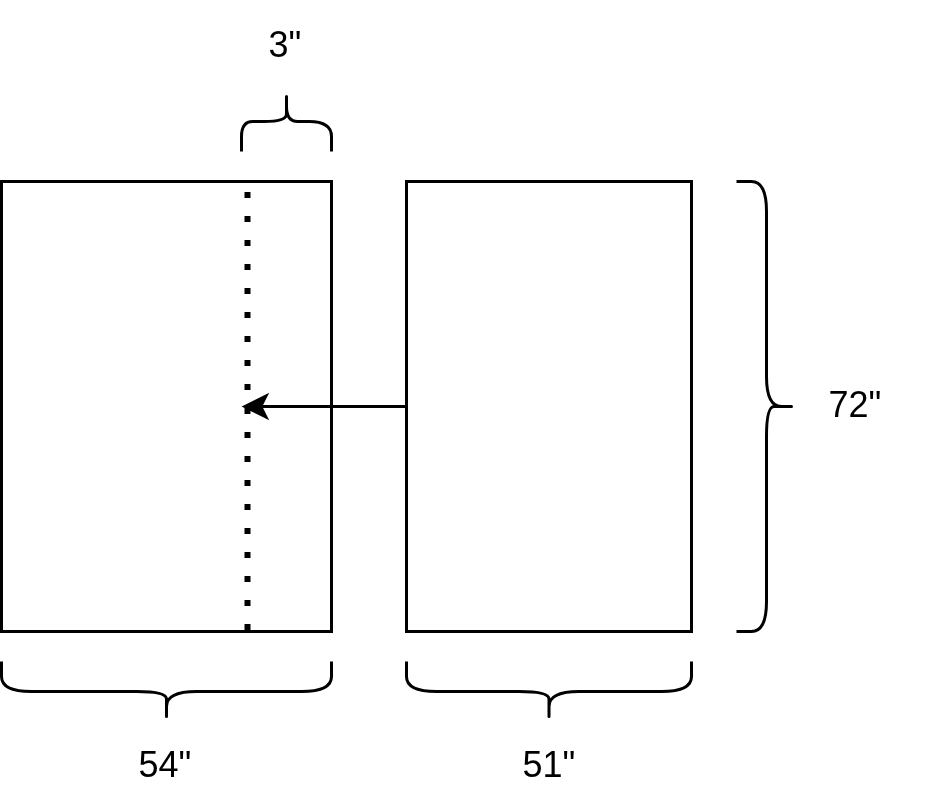
The cover consists of four sections: front, back, and two sides. On top of the white base we add the trim and the symbols. Marine Vinyl is sold in bolts of >54” width (usually slightly greater than the nominal 54”, typically 55”). One width of the vinyl was not sufficient for the entire width of the canopy. I chose to use two 72” lengthwise pieces for the main section of the cover so that the seam would rest near the top of the frame and be less visually obvious than a seam across the width. One width of the vinyl was enough for the front and back sections.

For the frame members, I chose Azek PVC siding because it was relatively lightweight, waterproof, and easy to cut and drill into. Wood would have warped or retained water. The PVC also had the right amount of flexibility. With 6’ length members, the bearers could hold the canopy at slightly different heights and it would still keep its overall form.

Design of the symbols

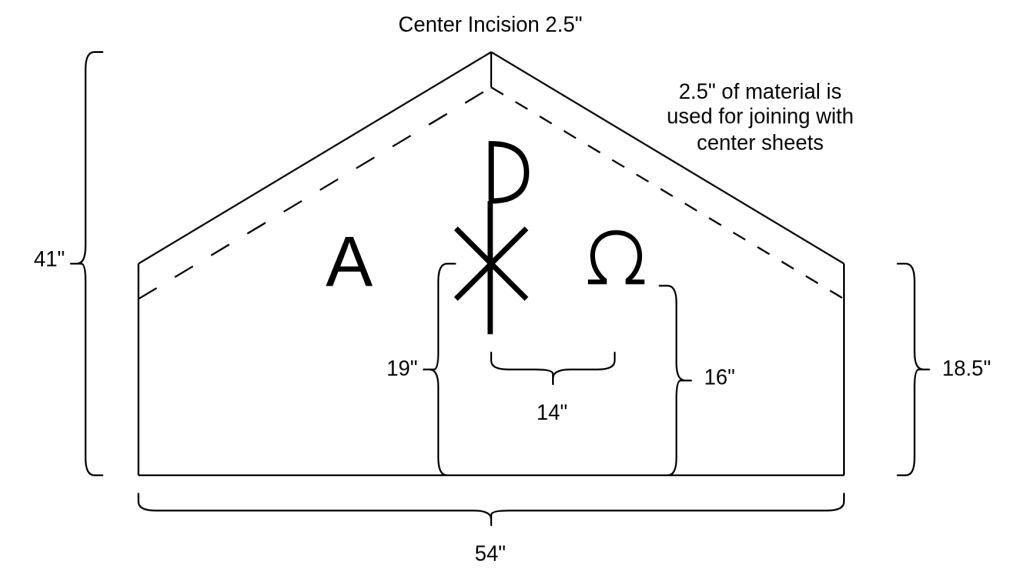
I used an off-the-shelf design for the Omega and manually sketched the patterns for the Alpha and Chi-Rho. In retrospect, the Omega would have been more visually recognizable at a distance with a “weightier” design similar to the Alpha or Chi-Rho. The Alpha was scaled to 7.5” in width and height. The Omega was scaled to 7.125” height and 7.25” width. I chose to make the Alpha slightly taller and wider because the pointed corners have less visual imprint than the rounded or block edges of the Omega. The Chi-Rho was 23” tall and 15” wide, with the center of the Chi 9.5” from the bottom of the symbol. The Alpha and Omega were set to visually “fit within” the Chi.

Bill of Materials

  1. 7 yds white Marine Vinyl
  2. 2 yds yellow Marine Vinyl
  3. 1 lb box of 1.25” screws
  4. 6x 3” screws
  5. 4x M10 100mm Dowel Screws
  6. 4x Double-Ended Clips
  7. 8x Eye Screws
  8. 12x 1/4″-20 x 2″ bolts
  9. 12x 1/4″-20 wingnuts
  10. 4x 4’ by 1.75” dowels
  11. 4x 3’ by 1.75” dowels
  12. 7x 8’ sections of 1”x2” (nominal, 1.5”x0.75” actual) PVC siding
  13. 8 oz of Vinyl Cement
  14. 2x LED lights for interior illumination

Fabrication

Poles

Drilling the holes for the dowel screws and assembling the poles: At first, I tried to make a collar wooden jig to assist in drilling the holes for the dowel screws. The jig fit snugly around the dowel and had a top piece of wood 3/4” thick. In the center of the top piece was a hole through which I could drill straight down into the dowel, with the hole providing the angular alignment. However, the small angular imprecision of the jig hole was magnified in the dowel, which made this unworkable. In the end, I was able to manually drill a hole directly in the dowel with satisfactory alignment. Part way through inserting the dowel screw into the 2nd dowel, I used the two dowel pieces as levers to adjust the angle of the interior screw by warping it. This was not apparent in the final assembly. The collar part of the jig was still useful in helping me draw an X to mark the center of the dowel end as the target for drilling. Of course, this process could have been avoided with a drill press and more formal centering tooling. Using 7’ poles would likely have been significantly more expensive due to rarity.

After joining the two dowel pieces together, I pre-drilled a small hole for the eye screws about 3/4″ from the top of the pole and inserted the eye screw that is used for the clips to the frame.

Frame

Assembly of the frame: Cutting all PVC pieces was easy with a circular saw. I sanded down any irregularities in the cut ends.

  1. 6x 70” – length members
  2. 2x 53.5” – triangle bottom pieces
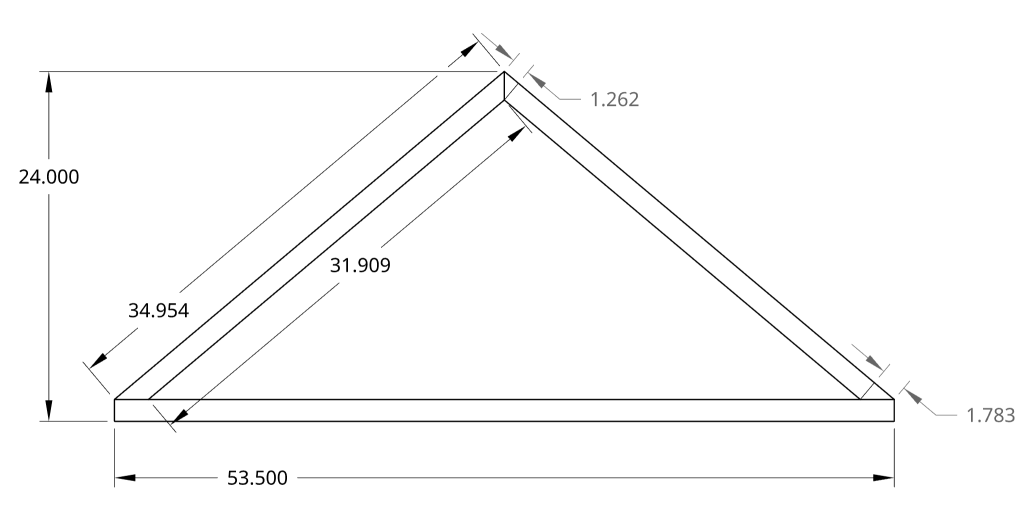
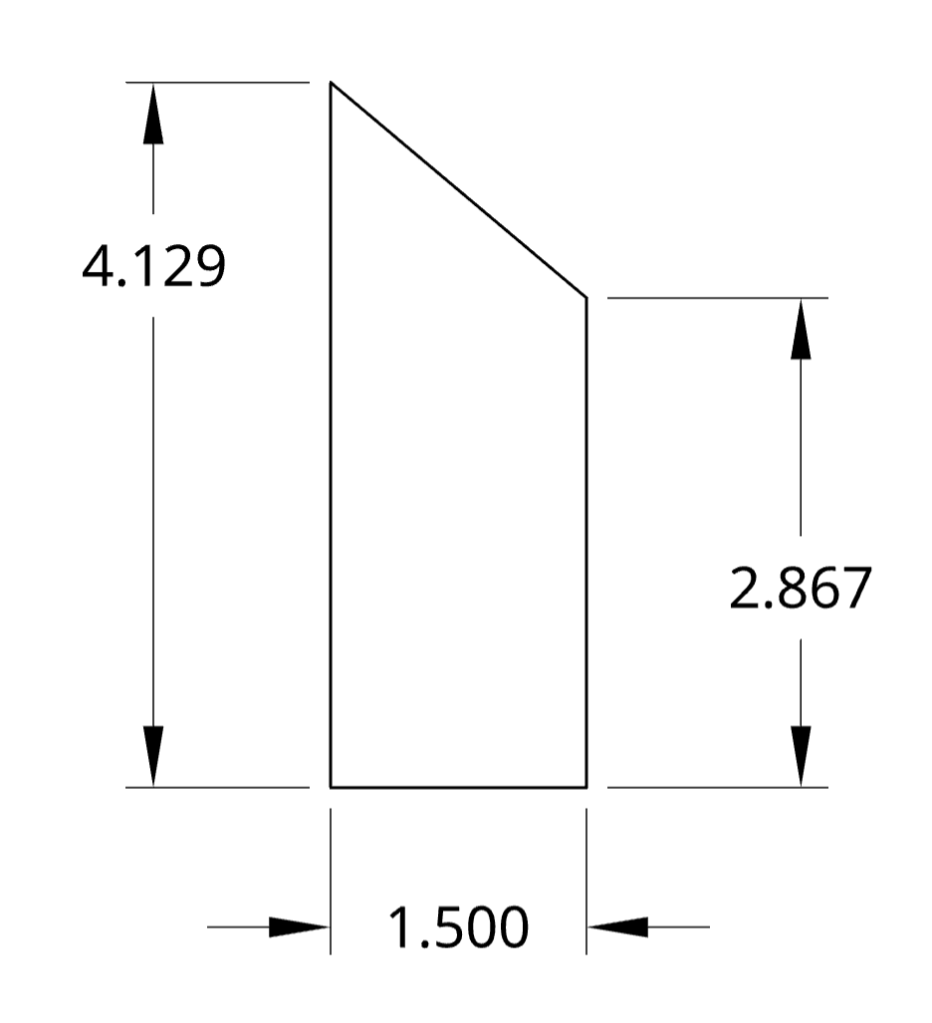
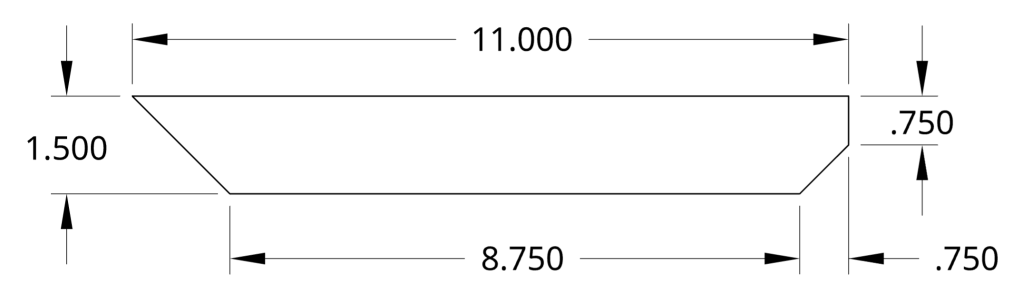
  3. 4x 35”, with angled cuts in – triangle side pieces (see below)
  4. 6x 6” – junction pieces for length members
  5. 2x 6” – triangle top brace pieces
  6. 6x junction brace pieces (see below)
  7. 4x triangle side brace pieces (see below)

Triangle Frame Pieces

Triangle Side Brace

Junction Brace

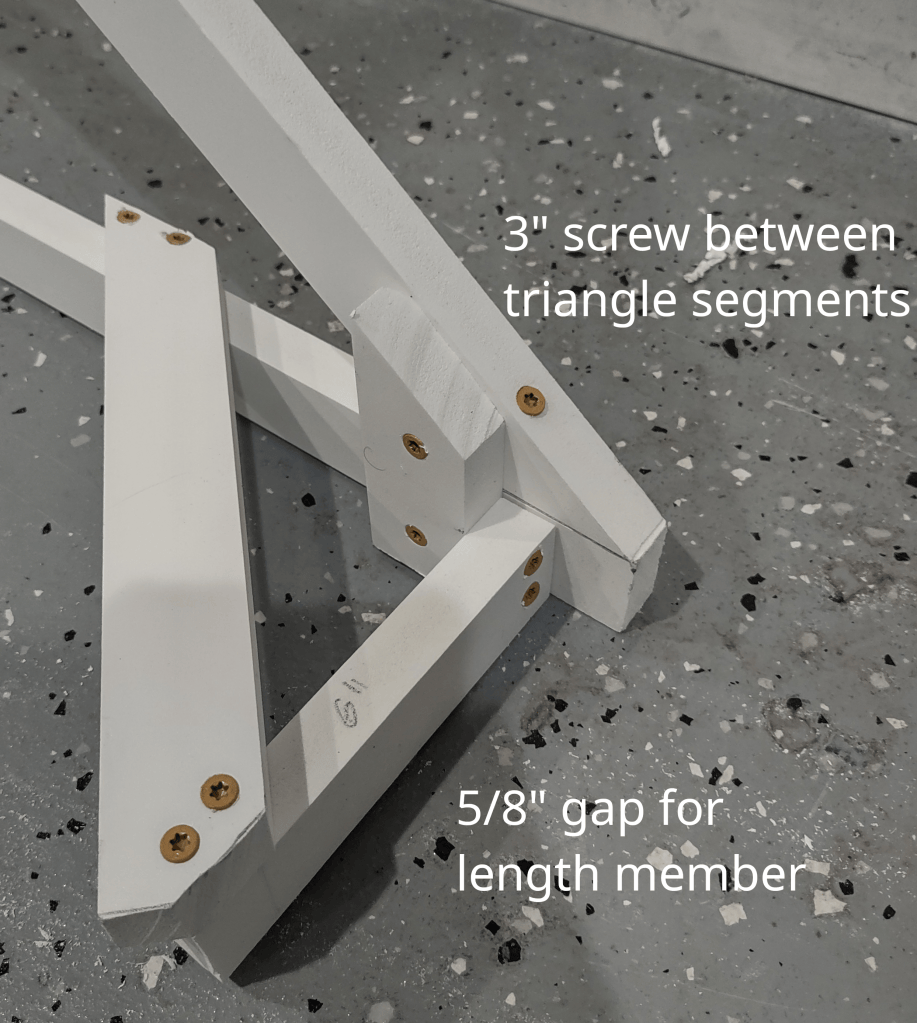
Assembly of the front and back triangles: I started with the three main pieces of each triangle and the small brace at each corner. I found that it was not necessary to pre-drill the holes. Each corner of the triangle gets a single 3” screw on its narrow side to connect it to the other main pieces and a small brace on its broad side that uses 1.25” screws. The junction and brace pieces also use 1.25” screws. Below is an example of the side corner for each triangle.

Make sure to mirror the junction at the top of the triangle for the front and back so that the broad side of the junction faces the same direction when the frame is assembled. Note that the junction piece in the below image should be flush with the triangle side on the right, not parallel to the one on the left. The ridge of the length member will still be between the two peaks because the junction was measured at 3/4” from the peak.

2nd Perspective on Top Junction (within full assembly)

Once the front and back triangles are complete, set up the length members of the frame between the triangles. Tape the top length member to its junctions temporarily. Drill the bolt holes through the length members and the junctions as they are in place together, then insert the bolts and wing nuts as each junction is drilled. Mark which side of each length member goes with each junction.

After the cover has been fully glued together on the frame, pre-drill a small hole for the eye screws on each side face of the triangle bottom beams and insert the eye screws.

Cover

Cutting the symbols: I traced the outline of the symbols in left-right reverse on the back of the yellow vinyl. Shown below are the tracings for the symbols that would go on several of the canopies (one was made in the first iteration, three more in the second).

Cutting the main sheets: The lengthwise sheets are 6’ long and need to combine to be 102” wide. The vinyl bolt is nominally 54” wide and may vary, so the exact dimensions or overlap between the sheets might not exactly match the below image. Sheet sketches are not to scale.

Lengthwise Sheets – 3″ overlap for joining.

Front and Back Sheets:

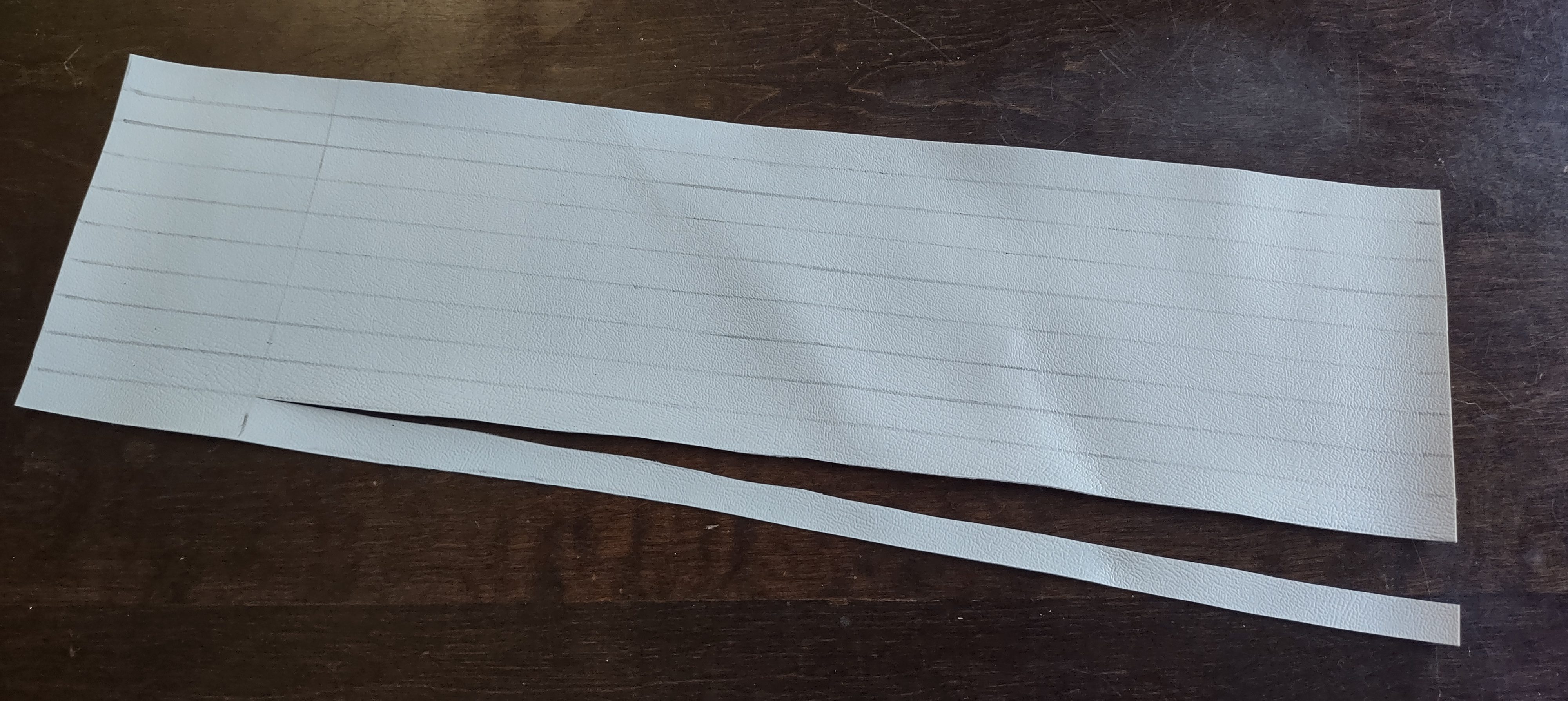
Fabric ties: We need to secure the cover to the frame in an easily reversible way. I chose to use ties made from the same Marine Vinyl fabric. The ties have one head section of 3” and two tail sections of 15”, each 1/2″ wide. The head section will be glued to the interior of the cover and the tails can be tied together around the corners of the frame. The tracing for a group of these ties is shown below.

Gluing the Cover

Marine Vinyl is easily gluable with Vinyl Cement. Vinyl cement needs to be used outside or in a room with high ventilation.

Gluing the symbols to the front and back pieces: I used a pencil to lightly trace the outlines of the symbols. I then used double-sided tape to tack the yellow vinyl symbols in place. Starting from the middle of each symbol, I folded the symbol vinyl away from the white vinyl and added glue to the white vinyl, trying to stay within the outline. Then I unfolded the symbol vinyl onto the region with glue and pressed them together. It was easier to achieve evenness in the distribution of glue over the glossy side of the white vinyl than to spread it over the back of the symbol vinyl. The recommended usage is to add the glue to both surfaces, but I found that the glue would soak in to the back of the yellow vinyl and cause it to warp. Pressing against the top of the symbol vinyl into the white vinyl got a flatter and cleaner result, even though it required adding glue only to the outlined region. When I sometimes added glue outside of that region, I was able to clean it up using the back of scrap white vinyl. The double-sided tape helped with keeping the rest of the symbol in place while portions of it were being folded or glued together. I waited about a minute after gluing each section of the symbol to allow it to set. The corners of the symbols required particular attention and sometimes slightly more glue to get a proper hold.

Gluing the trim: the 2″ yellow trim adds a small visual accent to the canopy perimeter. Similar to the symbols, we first trace the outline on the side of the front, back, and side pieces that will be at the bottom of the cover. Then we gradually add glue in sections while unfolding the yellow vinyl.

Gluing the two lengthwise pieces together: We want the lengthwise pieces to be parallel and maintain a consistent overlap region. We can cut the lengthwise pieces directly from the source bolt so that the longer sides are clean. The newly cut shorter sides will be glued to the front and back pieces with more than enough overlap, so it is OK that the cut may have some irregularity. I laid out one lengthwise piece and rolled up the 2nd piece so that it could be unrolled progressively to glue the two together. I first lightly traced the intended receiving region on the bottom piece. From there, I tacked the two pieces together using duct tape on one end, shown below. It is important to get the initial section of the two lengthwise pieces to be square against each other so that the parallelism is maintained while unrolling. Starting a few inches from the end of the cover, I gradually added sections of glue to the receiving surface and unrolled the 2nd roll onto it, briefly pressing the two pieces together and waiting. With each new section, I checked and readjusted the alignment of the two pieces. The vinyl has a little stretch to it and so permits small curves without rumpling. Finally, I went back to the section under the tape and added glue there. Doing the end sections last made it easier to make them straight.

Gluing the front and back pieces to the lengthwise cover: I chose to glue the cover together while the pieces were on top of the assembled frame to make sure the overall fit was secure but not too tight to move on and off. First, I used duct tape to tack the front and back pieces to the triangles, shown below. I checked that there was approximately 14.5” of fabric overhang at both corners, and critically that the fabric was square with the frame. Note that because the width of the frame was 53.5”, but the actual fabric may be 54-55” wide depending on the bolt, the front and back pieces will have some overhang which we trim after all gluing is complete.

Once the front and back pieces were set, I laid the lengthwise piece over the middle and aligned the seam about 3” from the peak at both ends. I checked that the overhang of the fabric was close to even on the two sides of the frame. I then tacked the lengthwise piece to the front and back with duct tape to secure it for gluing. Finally, I worked outwards from the peak, gluing sections of about 4” at a time. I removed the exterior tacking tape as needed with each section. When complete, it looked as shown below.

Trimming the excess and making space for the eye screws: On the front and back pieces, I measured how much excess needed to be trimmed to make the sides of the overhang square with the frame. On the lengthwise piece, I measured the length of the sides needed to expose the 3/4” thickness of the front and back beams, and trimmed that amount. This cut is needed so that the cover doesn’t sit on top of the eye screws that connect the poles to the frame.

Fabric Ties: Glue the fabric ties to the interior of the cover near the corners of the lengthwise piece, set back from where the frame will match against the cover by about 2”. As before, apply the glue to the glossy side first and press the two pieces together. In the first iteration, I manually sewed the ties into the cover, but this created tears in the fabric and some of the ties eventually ripped out. Gluing was more secure and did not create tears.

Canopy In Use

Usage Instructions

The following usage instructions are written to stand alone for users of the canopies, so some of the content is repeated from above.

Assembly/Disassembly

There are three major components of the canopy: the frame, the cover, and the poles. Start by assembling the frame. When assembled, the frame looks like the following image (minus the duct tape). The frame is 53.5” wide, 71.5” long, and 24” inches tall.

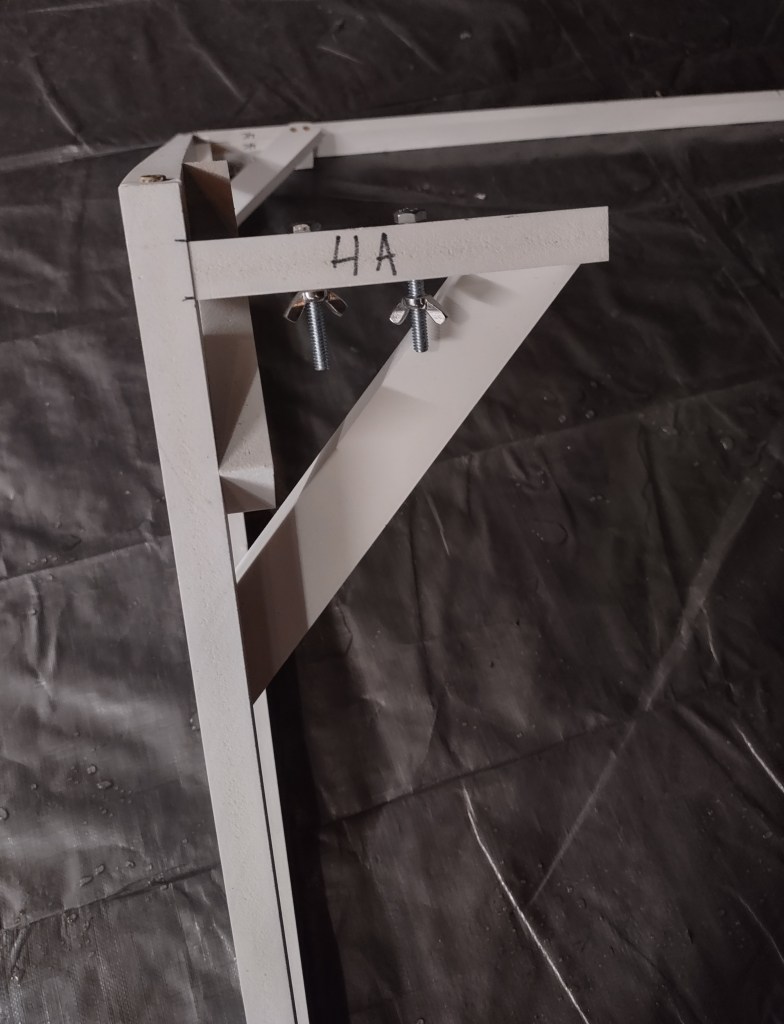
The frame is disassembled to be transported into the two triangles and three beams. The triangles are connected with bolts and wing nuts to the beams. In the below images, you can see the wing nuts in place on the bolts that go through the two bolt holes that are on each side of each beam.

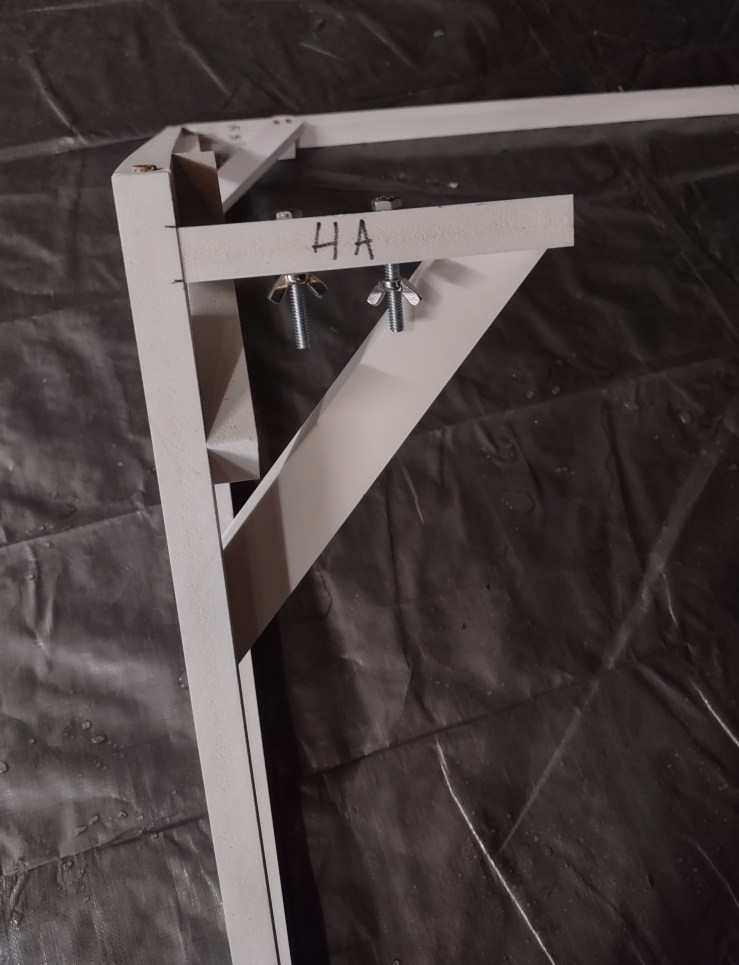
On the completed frame, you will notice that there are numbers and letters on each point of the triangles and each side of the beams. The numbers and letters must match for the pieces to fit together. All frames are unique due to their manual creation. The bolt holes were drilled manually and so only match within each specific frame. The number is the serial number of the canopy and the letter is the position of the junction on the frame. The image on the right shows an example of the number and letter on one junction point of a triangle. When disassembling the frame for transportation or storage, be sure to put the bolts through the bolt holes and fasten the wing nuts. This will prevent the pieces from getting lost.

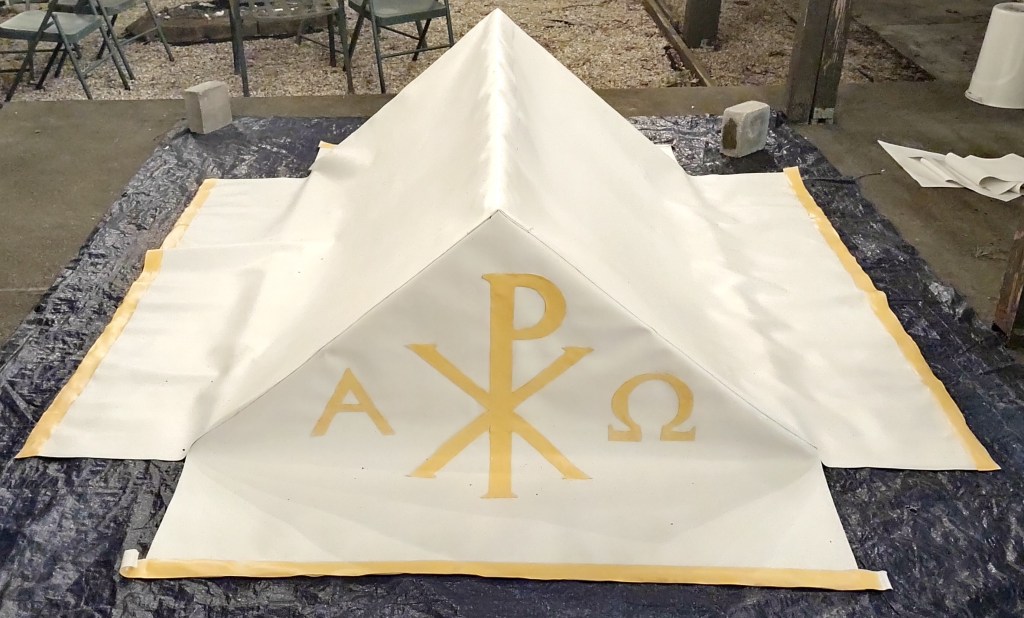
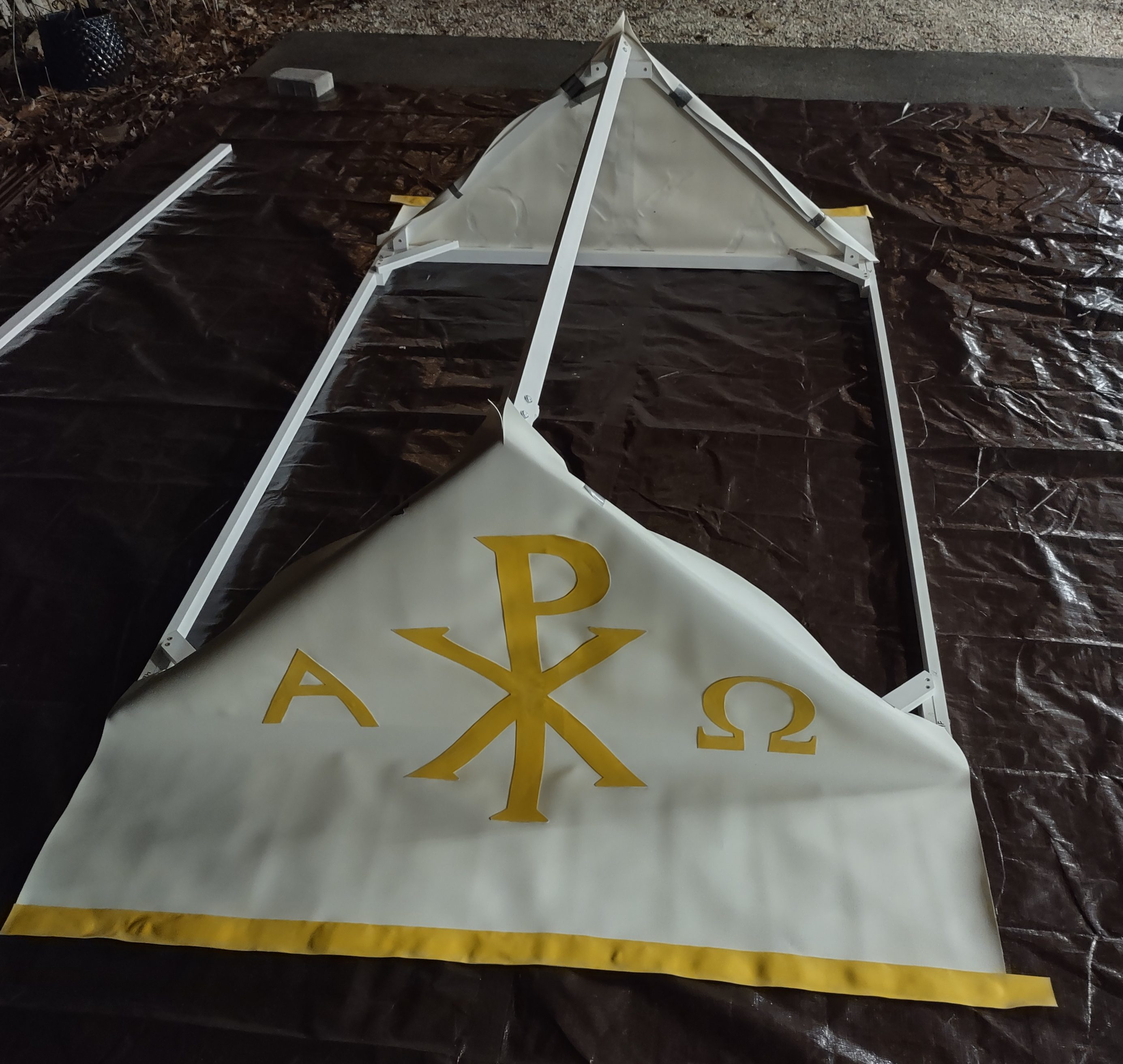
Once you have assembled the frame, unfold the cover and place it over the frame. On the ground, it will look similar to the below image (the excess yellow trim was removed after this picture). The cover is 72” long, so there is about 1/2” of tolerance between the frame and the cover to allow for easy assembly and removal.

At each of the corners of the cover on the ground that are adjacent to the corners of the triangles, there are fabric ties to secure the cover in place. Tie them around the corner of the assembled frame. Finally, connect the poles to the frame with the double-sided clips. The poles are 7’ tall. In use, it looks like the following image:

After use, be sure to keep the clips connected to the triangles so that they do not get lost. The poles are 84” long, while the beams are 70” long, meaning that storing and transporting the assembled poles does not take much more space than the beams themselves. It is recommended to not disassemble the poles for storage so as to not wear out the interior of the wood from repeated screwing and unscrewing which will make the junction weaker.

Processing with the Canopy

The canopy frame is intentionally rigid so that rain water flows off the sides. This means that it is important to be aware of any obstructions in its path while processing and route around them. The responsibilities of the front bearers are to look out for obstacles and occasionally look to the side to confirm height alignment with the other front bearer. The rear bearers should look ahead and try to keep the frame level with the front bearers. The clips on the corners of the frame are not rigid and allow for some tolerance in the relative position of the poles. However, the bearers should still try to walk in unison. Bearers should practice walking with the canopy before the procession to learn how to travel together and hold the canopy at a consistent height.

Folding the Cover

If the canopy needs to be stored or transported, try to fold the cover primarily along its major seams. The front and back pieces can be creased at their middles with the side piece lying flat at the ground. Then, fold the front and back pieces inward, and once again in the middle of the side pieces. This will minimize the number of creases in the cover. The creases should also come out naturally after the cover has spent time in the fully assembled canopy form.

Cleaning the cover

The cover is made from marine vinyl, which is naturally waterproof. If the cover gets soiled or dirty, rub it with a wet cloth with dish soap. Be sure to dry it before folding it because the water will be trapped otherwise. More extensive cleaning is possible but requires specialty cleaners.

Patching the cover

If for any reason the cover gets torn, spare marine vinyl can be used to patch it. A piece that is about 2” wider than the tear on all sides should be glued on the interior of the cover.

History of Science in the Catholic Church to the High Medieval Era

Where did “Science” as we know it come from? Why did Science, as an enterprise, arise in the West? Many today would say it came from the Enlightenment, or the early modern period with Francis Bacon and Galileo. But we need to look deeper back in history to understand its conceptual foundations. While reasoning about intellectual history requires caution and circumspection, here I will try to advance a perhaps controversial claim: that the origins of a scientific worldview arose specifically from Christianity. Examination of the relation between faith, reason, and science in the history of the Church shows how Christianity begot or strengthened several patterns of thinking necessary for science. These patterns are: the Orderliness of Creation, the Goodness of Creation, Primary and Secondary Causality, Unity of Truth, and the Universal Destination of Goods. Here I will focus on the period from the beginning of Christianity to the beginning of the public enterprise of experimental science in the high medieval era.

“In the beginning was the Word, and the Word was with God, and the Word was God. He was in the beginning with God; all things were made through him, and without him was not anything made that was made. And the Word became flesh and dwelt among us, full of grace and truth; we have beheld his glory, glory as of the only-begotten Son from the Father.” (John 1:1-3, 14). Jesus Christ, the Second Person of the Trinity, is both mediator of creation and salvation, and dwelt among us. The Orderliness of Creation is clear throughout the Old Testament, but Christ’s Incarnation fundamentally changes our understanding of the Logos. Our faith in Christ and His Salvation is intertwined with our rational engagement with the ordering principle of the created world, which is no longer merely a principle, but is Christ. Study of the created world gains new dignity as another means of understanding His Goodness. It may be an act of reverence and not simply gain for oneself. Further, this intertwining demands intellectual and spiritual humility from the student. This humility is the seed of honest science.

Now we can turn to early Christianity’s engagement with the wider world, starting in Acts. “Men, why are you doing this? We also are men, of like nature with you, and bring you good news, that you should turn from these vain things to a living God who made the heaven and the earth and the sea and all that is in them.” (Acts 14:15) When some Athenians believe that St. Paul and St. Barnabas were Zeus and Hermes after observing Paul’s healing of a cripple, Paul rebukes them and asks them to turn to God alone. Paul preaches the unity and orderliness of Creation to the Athenians. Polytheism was an obstacle to science because if phenomena on Earth were the work of capricious or competing deities, one could not expect the regularity or consistency required for study. In contrast, the author of miracles is the same as the singular author of the workings of the world. When Paul returns to Athens after some time (Acts 17:16-34) he again exhorts them to turn away from false idols, meets with Epicurean and Stoic philosophers, and cites Greek poetry (17:28) to relate to them and explain that God is the source of life, greater than the art or imagination of Man. This encounter with the pagan and philosophical Greeks began the long dialogue between Christianity and classical learning that would prove essential to the emergence of Western science.

The Meaning of Number

“But thou hast arranged all things by measure and number and weight.” (Wisdom 11:20) In The Journey of the Mind To God, St. Bonaventure (1221-1274) begins by describing how through experience of the world we are drawn to contemplate the First Principle. Bonaventure argues that it is necessary that everything be numerical: God’s creation is ordered, purposeful, and beautiful; symmetry and proportion are the basis of beauty, and these require number. God’s wisdom is stamped on created things and “number is the foremost exemplar in the Maker’s mind”, but only God is eternal. Recognition of order within creation is among the first steps of the path of devotion to God.

Jews and Christians were not alone in this inspiration: the ancient Greeks, Babylonians, Egyptians all saw beauty in mathematics and sought to understand the world through it. So what was the difference? Even though mathematical rationality is one stepping stone to wisdom, for the Christian, it is not the final destination. In the Platonic conception, the material world was an imperfect emanation of the transcendent world of forms. Plato’s Timaeus hypothesizes how the behavior of each of the classical elements is based on its corresponding regular polyhedron (what we today call Platonic solids). For Plato, geometry and pure reasoning is the path to understanding the workings of the whole universe.

There are a few problems here for scientific study. Firstly, denigration of the actually existing world that we experience in favor of transcendent geometry makes it difficult to integrate empirical inquiry, if one takes the Platonic conception seriously. On the other hand, the Christian understanding of incarnate Logos changes the significance of the material world to a worthy object of study that is divinely ordered. Understanding that mathematics is simply one part of our rationality that we ought to use neither ignores its utility nor misplaces it as the supreme end.

The second problem of the Platonic system is more subtle and requires discussing the concept of “The Great Year”. Classical pagan cosmology was founded upon a belief in a cyclical universe. For Plato, “The Great Year” or perfect year was the period over which all planets, with their cycles of different lengths, would return to their original positions. Later astronomers such as Hipparchus would base the Great Year on the procession of the axis of the Earth. When combined in a belief in astrology, the Great Year was the “cycle of ages” over which period everything would recur. In Timaeus, time is a moving image of unchanging eternity that is shown in the motion of the stars. Astronomy is the approach toward the singular, cyclical, eternal, and mathematical entity that is the source of the image that is the cosmos. In Science and Creation: From eternal cycles to an oscillating universe (1974), historian of science Fr. Stanley Jaki argues that it was precisely this belief in a cyclical universe that undermined a scientific understanding of causality and inhibited progress towards empirical physics, as will be described more in the next section. Christianity requires belief in linear history and the gradual unfolding of the plan for man’s salvation, accompanied by the possibility of increase in knowledge. This is contrasted with the fatalistic pessimism of cyclicity. Modern people take this linear understanding of history for granted, but it was not commonly accepted outside of a Judeo-Christian context.

The progress of science undoubtedly drew from ancient pagan astronomers and geometers, but Christian authors such as Bonaventure properly situated mathematics as an aspect of God’s creation rather than the essence of the eternal. Today, we employ mathematics as a tool in scientific study without regarding it as divine.

Beginnings of non-Aristotelian Dynamics

Pierre Duhem was a Catholic chemist and historian of science active in the early 20th century. Duhem put forward the thesis that the beginning of the thread of modern science in the West can be placed at the reevaluation of the status of Aristotelianism at the University of Paris following the death of St Thomas Aquinas (1274). This may seem outlandish at first, but by considering Aristotle’s physical theories and the transition away from them, we can better understand the conceptual foundations of mathematical physics.

While Aristotle had written profitably about many subjects, his understanding of motion presented basic problems, though the lack of an alternative comprehensive physical theory and his status as the preeminent philosopher kept many from challenging it. Aristotle believed that motion happened when two bodies swapped places. All bodies were drawn to their natural place: earth to the lowest place, water the second lowest, air to the second highest, and fire to the highest. Natural motion was when bodies moved to their natural places, and violent motion was when they were moved away from it by some other actor. This matches intuitive experience, which is that heavy bodies fall within water, air bubbles rise within water, fire rises within air. For Aristotle, at no point during motion was there a gap or absence of a body, i.e. a vacuum. Part of Aristotle’s reasoning for rejection of the vacuum was that he believed that speed was the result of a conflict of a mover and a resisting medium, depending on the medium’s density. Without resistance, Aristotle thought that speed would become infinite, which he took to be absurd. Aristotle incorrectly believed that the projectile motion of heavy bodies was sustained by a burst of air that followed the projectile. This was not satisfying to many of his readers, but it was part of a comprehensive account of cosmology that did not have a clear alternative and was buttressed by Aristotle’s general authority.

Conflict over how non-Christian authors should be interpreted and related to Catholic theology came to a head after the death of Aquinas. Aquinas drew from Aristotelian conceptions of form, matter, and causality to better explain theology, but Aristotle’s thinking was not fully consistent with Catholic understanding of the world. The foremost problem was that Aristotle believed that the world was eternal, rather than created. After Aquinas’s death, the bishop of Paris, Étienne Tempier, issued a set of condemnations of certain Aristotelian propositions (1277): among these was Aristotle’s assertion that the vacuum was impossible. Why was this condemned? The bishop argued that anything that is not a logical contradiction was within God’s power to create, including the vacuum. Students of natural philosophy now had not only license but invitation to theorize about motion in the vacuum, which was motion without a resisting medium.

One such natural philosopher was Jean Buridan (1300-1358), priest and member of the faculty of the University of Paris. Buridan developed a theory of impetus, a motive power imparted by a mover onto a moving object that is not naturally diminished by motion, and would remain in motion until met with some contrary force. Buridan’s theory had predecessors in John Philoponus (6th century) and Avicenna (930-1037) but was distinguished from the former in that impetus does not diminish with time or movement alone, and from the latter by his statement that the ability of a body to receive impetus was proportional to its amount of matter and to the initial imparted speed. (Buridan, Questions on the Physics, p. 535) Buridan applied a mix of empirical observation of different bodies in motion and thought experiments about how motion would be affected under varying conditions to reject Aristotle’s account. In a similar way to how introductory physics courses ask students to calculate the trajectory of a projectile assuming no air resistance, Buridan reasoned from the absence of a resistive medium to describe the possibility of sustained motion via impetus. Further, Buridan hypothesized that at the creation of the world, the planets were set in motion by God, and without a contrary force, they could move indefinitely. This would resolve a question in Aristotelian cosmology of what sustains the planets in motion. While Buridan observed that heavy bodies fall and gain impetus, he did not have a theory of universal attraction that would only come later with Newton putting all of the pieces together into a single mathematical system.

Later, Nicole Oresme (1325-1382), bishop of Lisieux, further developed this by creating the first graphical representation of time versus motion. Prior natural philosophy relied solely on verbose description of physical relations and did not use equations. Oresme showed graphically that a uniformly accelerating body would travel a distance equal to its mean speed multiplied by the duration of motion. While today we may think of this as basic, it was a step towards abstract mathematical reasoning applied to physics. Oresme also argued in favor of assuming the rotation of the Earth to explain the apparent motion of the stars on account of simplicity. He even drew an analogy between the motions of heavens and the working of a mechanical clock, with God as a clockmaker and the world moving according to its original design. This went further than a Platonically-inspired belief in the creator as the “Great Geometer” to God who sets the world in motion according to physical laws.

What are we to make of this episode on motion in a vacuum for the relation of Christianity to science? To what extent can we attribute these advances to Christianity, versus a general gradual development of learning? Buridan’s statement of the consistency of motion in the heavens with motion on Earth affirms and was built upon belief in the physical unity of Creation. In contrast, Aristotle believed that the celestial sphere was unchanging and followed different patterns from the mutable terrestrial sphere. Acknowledgement of God as the singular author of physical laws allowed speculation and thought experiment to go beyond the intuitive dynamics of Aristotle. To make a conservative statement, monotheism and belief in a created universe that unfolded based on God’s plan certainly helped in this advance.

Why did medieval Islamic science not develop in the same way? The common answer is that Christian scholars avoided the Occasionalism among Muslim scholars typified by al-Ghazali. Occasionalism denied that entities have causality in themselves and attributed causality only to God. Al-Ghazali sought to refute Avicenna’s account of natural causation based on the absoluteness of divine omnipotence. Aquinas defended the causality of created things (secondary causality), after God’s primary causality of creation and sustainment in existence, based on the perfection of creation which includes entities having order as part of the whole. Aquinas explicitly linked the propriety of wisdom having utility in natural science with why it is fitting for creatures to have natural effects (Aquinas, Summa Contra Gentiles Book III Ch 69 Article 13, 15, 17-18). The more complete answer to the above question is that Christian belief in the Incarnation affirms the goodness and dignity of creation and thus also its possession of orderliness in itself.

Buridan’s theory of impetus did not gain wide acceptance immediately. Duhem traces the lineage of non-Aristotelian dynamics from Buridan through Oresme and Albert of Saxony, to Leonardo da Vinci, Copernicus and then Galileo (as the major figures), while proponents of Aristotle were still common.

Transition of Alchemy from a private, inwardly-oriented science to public, outwardly oriented

The study of the stars has occupied many learned minds from the ancient era to the present day. It served to determine the calendar, and for those who believed in the influence of the stars and planets on earthly affairs, it had political and religious significance. Rulers supported astronomers in their work on “higher things”. The Platonic esteem of geometry harmonized with the prestige of astronomy. We will contrast this with the status of the study of “lower”, earthly materials, which for the ancients was alchemy. Through this contrast and consideration of the work of Roger Bacon, we can learn about the reevaluation of the precursors to chemistry and its relation to Christianity.

Alchemy focused on the attempt to transform lead or silver into gold, but encompassed the rudimentary classification of materials and their interactions. To the modern reader, this transformation sounds fantastical, but we should begin with why it was considered plausible in a pre-modern understanding of the origin of substances. Lead and silver frequently co-occur in mineral deposits, as do silver and gold in a combination called electrum that was used for ancient coins. Refinement of these metals into their constituent parts and purification of them were important aspects of early metallurgy. Given their co-occurrence, the ancients believed that there were some similar generating principles for them that could be discovered and used to transform one into another. The obvious problem was that if successful, alchemy would devalue the currency. While astronomy had royal support, alchemy faced opposition such as in 292 AD when the Roman emperor Diocletian ordered the burning of alchemical works in Alexandria, and for general suspicion of fraud and charlatanism. Further, it was the study of “lower” things and did not have the mathematical beauty of geometric astronomy. For all of these reasons, alchemy and related mechanical arts such as metallurgy were not included in standard university Arts curriculum (Trivium: Grammar, Logic, Rhetoric; and Quadrivium: Arithmetic, Geometry, Astronomy, Music).

Roger Bacon (1219-1292) was a Franciscan friar and scholar at the Universities of Oxford and Paris. In his Opus Maius (Greater Work) Book VI De Scientia Experimentalis (On Experimental Knowledge), he presented novel work on optics and argued for the integration of experimentation into the teaching of students. He argued that experimental science and specifically alchemy were valuable to study for three reasons: to dispel the fraud of magicians and allow people to understand what is accomplished by natural means, to create better medicines, and in writing about gunpowder which was new to the West, to create better weapons for the defense of Christendom against Mongol invasions. These justifications of science for knowledge, health, and defense are quite similar to the modern motivations for public science funding. This work was presented to Pope Clement IV who was a scholar at the University of Paris and corresponded with Bacon before his election as Pope. Bacon wrote that students were largely unfamiliar with experimentation and that disputation on ancient authors was insufficient.

Modern interpretation of Roger Bacon’s work often focuses on the possibility of ascribing the beginning of the experimental method to him, and to what extent he attempted to be mathematical in his work. In so doing, it applies too much of a retrospective lens and fails to engage with him in what he aimed to do, which was to make the case for the legitimate study of alchemy in a formal academic setting. This legitimization was needed to counter the suspicion cast on attempted gold making and false medicines. Alchemists and metallurgists were, of course, active and systematic empiricists but did not work “above ground”. Their efforts were often combined with astrological interpretations of the correspondences between specific substances and the stars or numerological hypotheses about the degrees of purity of metals. Bacon entertained but did not fully adhere to these superstitious aspects to alchemy, which will be expanded on below.

The systematic accumulation of experimental results on terrestrial subjects paired with attempted comprehensive mathematical accounts of those results (even if wrong) first occurred with the alchemists. We state “comprehensive account” to distinguish alchemy from architecture, which did have a geometric basis and was built upon accumulated practical knowledge of successful projects, but did not attempt to explain the full underlying causality of phenomena. The account of causality is necessary for science distinct from art.

While we can recognize Roger Bacon’s contributions, at the same time we should caution against believing him to be an example of a comprehensively scientific outlook. St Augustine of Hippo and other Christian authors argued against astrology, but Bacon and others like him believed that astrology was legitimate not because the planets directly controlled events on Earth, but because of a perspective we can summarize as “cosmic harmony”: that the heavens and Earth were attuned to one another because of the harmony of Creation and so by studying the stars it should be possible to learn about affairs on Earth. Bacon still believed in free will but that the heavens ‘incline’ men to certain dispositions. This was not satisfying to Bacon’s contemporaries, including St. Bonaventure. In this, we see the “conflict of worldviews” for the medievals was not clear-cut and did not correspond directly to modern interpreters’ understanding of experimental science v. philosophy or faith. Bacon believed in different means of investigation into the workings of the world: mathematics paired with observation in optics, the creation of better astronomical instruments to go beyond direct observation, and compilation of authoritative sources in medicine to rediscover lost wisdom.

Given these problems, why do we need to recognize Bacon as important in the history of science and the Church? Bacon was a prominent voice in the reorientation of experimental science from something that was heavily suspect because of association with private gain (gold making, charlatanism) into a form of study needed for the public good. Experimental science could allow the disproving of false conjuration, restore health, and aid in the defense of Christians. Universities were founded as centers of learning in theology with preparation in Arts and Philosophy. Bacon succeeded in adding optics to the university curriculum as an applied science that joined together observation, geometry, and reasoned interpretation of results, and so expanded the scope of legitimate study. This required Christian confidence in the unity of Truth: investigation into the physical world could only strengthen the faith and disprove the pagans, even if there were prior associations of alchemy with deception.

Founding of Universities and their Mission

After the decline of Roman education in the early medieval era, bishops began establishing cathedral schools that trained future clergy and sons of the nobility in the classical Trivium and Quadrivium. Charlemagne (748-814) supported the expansion of these schools in his kingdom and ordered that every cathedral and monastery have an attached school (Admonitio generalis, 789). Later, in the Third Lateran Council (1179), Canon 18 mandated that every cathedral church must provide a benefice (salary for a position) for a master to teach clerics and poor scholars without charging tuition. These cathedral schools became nucleation points for higher education which eventually formalized into “universities” that defined standards for teaching, granting of degrees, and discipline. The prominent early universities were those of Bologna (1088), Paris (1150), and Oxford (1096) though these dates reflect the acknowledged beginning of some common institutional structure, with formalization happening gradually from the 11th through 13th centuries. Mastery of the Arts curriculum was required before moving on to the higher faculties of Theology, Law, and Medicine.

Historian Edward Grant in The Foundations of Modern Science in the Middle Ages places great emphasis on this curricular sequence and the university corporate structure for the explanation of the sustained progress of science in Europe. Universities existed as institutions centered on learning supported by the Church and separate from the patronage of any one ruler or dynasty, which carried them through times of political upheaval. Theologians were first trained on a broad base of the Arts curriculum. This created a class of learned men, some of whom had the leisure to pursue questions in natural philosophy and engage with the inheritance of ancient Greek learning, as we have seen with Bacon, Buridan, Oresme, and many others. Even those who would become lawyers, administrators, and clerks would gain exposure to natural philosophy through the intellectual community of the university. These institutions could preserve the writings of scholars more durably than private libraries.

This institutional account is palatable enough to non-Christian audiences, but we also want to take the specifically Christian aspect of universities seriously. The evangelical orientation of Christianity transformed study from an insular pursuit for the few to the outwardly directed service of the whole world following the Great Commission. St. Augustine of Hippo in On Christian Doctrine analogizes the sharing of spiritual and intellectual gifts in study of scripture to the multiplication of the loaves in the feeding of the thousands: “just as that the bread increased in the very act of breaking it, so those thoughts which the Lord has already vouchsafed to me with a view of undertaking this work will, as soon as I begin to impart them to others, be multiplied by His grace, so that, in this very work of distribution in which I have engaged, so far from incurring loss and poverty, I shall be made to rejoice in a marvelous increase of wealth” (Bk 1, Ch 1). Building upon this evangelical foundation, preparation of priests in theology was joined together in the same institution with everything worth formal study in universities. In The Franciscan Concept of Mission in the High Middle Ages, E. Randolph Daniel uses Roger Bacon as the example to make this clear: “Bacon was a linguist and a proponent of the philosophical approach to mission. He believed that missionaries should study languages, particularly Hebrew, Arabic, and Greek, not only to facilitate communication with the non-Christian, but to establish a common ground of scientific and philosophical knowledge for rational disputation with him” (55). Christian confidence in the unity of truth emboldens one to pursue study for its own sake, out of love, and desire for engagement with the world.

Summary of the Foundations of Science

To summarize the relations between Christianity and science up through the High Medieval era when we can recognize science’s beginnings, we can state certain “foundations” or prerequisites for science to function, and assess if and how Christianity contributed to them.

  1. Orderliness: Orderly account given of physical phenomena with entities having natural causality (Orderliness of the world, Primary and Secondary Causality)
  2. Mathematical Structure: Such an account having a mathematical basis,
  3. Unity of Laws: Unity of physical laws through the observable world,
  4. Institutional Propagation: Inquiry supported by a long-living institution with orientation toward dissemination of knowledge (Universities existing as entities separate from a specific personal patron, requires conception of inquiry for public benefit, Universal Destination of Goods)

A belief in the orderliness of creation was strengthened by understanding of Christ as Logos. In contrast to pagan beliefs, the stars and planets were part of the same created world, subordinate to God, and subject to the same laws. Christian scholars believed in the distinction between Primary causation (God’s Creation and sustainment of the world in existence) and secondary causation (creatures having natures that cause physical phenomena). They avoided Occasionalism, owing at least in part to their belief in the dignity of creation.

Christianity’s missionary orientation drove engagement with the learning of the rest of humanity and established universities dedicated to the propagation of knowledge, both theological and worldly. While guilds and alchemical circles guarded knowledge for private benefit, universities were structured toward the universal destination of goods, as shown in Bacon’s recasting of the purpose of studying alchemy. The universities as institutions supported clerics and scholars who studied widely and did not depend on the patronage of a specific ruler or dynasty, unlike scholars in the Islamic world who did not enjoy such institutional longevity.

For medieval clerics such as Buridan, the mathematical character of inquiry into natural causes was the fruit of productive engagement between a Christian understanding and older Platonic and astronomical traditions. While Biblical creation had a strong emphasis on order, proportion, and significance of number,we cannot ignore Plato’s Timaeus and the broader Greek interest in geometry in arriving at an explicitly mathematical understanding of the world that assisted in the formulation of physical laws of motion founded on quantitative relations. However, the Platonic account lacked a proper understanding of cosmological unity, adhered to cyclical history which was an obstacle to temporal causality, and wrongly divinized Number. The Christian worldview enabled metaphysical clarity that engaged with mathematics as a tool rather than an end.

The combination of these foundations formed the base of science as a public enterprise that we have inherited today.

References

  1. John Paul II. Fides et Ratio. The Holy See, 1998.
  2. Thomas Aquinas, Summa Contra Gentiles. Translated by the English Dominican Fathers. Burns Oates & Washbourne Ltd, 1924.
  3. Aristotle. On the Heavens. Translated by J. L. Stocks, Princeton University Press, 1985.
  4. Aristotle. Physics. Translated by R. P. Hardie and R. K. Gaye, Princeton University Press, 1985.
  5. Roger Bacon, Opus Majus. Translated by Robert Belle Burke, Russell & Russell, 1962.
  6. Bonaventure of Bagnoregio. The Journey of the Mind To God, Quarrachi Edition of the Opera Omnia S. Bonaventurae Vol. V, 1891.
  7. Jean Buridan. Questions on the Physics. Translated within The Science of Mechanics in the Middle Ages, by Marshall Clagett, The University of Wisconsin Press, 1959.
  8. Alfred W. Crosby. The Measure of Reality: Quantification and Western Society, 1250-1600. Cambridge University Press, 1997.
  9. E. Randolph Daniel, The Franciscan Concept of Mission in the High Middle Ages. The Franciscan Institute, 1992.
  10. Pierre Duhem. Galileo’s Precursors: Studies on Leonardo da Vinci. Translated by Alan Aversa, 2018.
  11. Pierre Duhem, To Save the Phenomena: An Essay on the Idea of Physical Theory from Plato to Galileo. Translated by Edmund Dolan and Chaninah Maschler. University of Chicago Press, 2015.
  12. Edward Grant. The Foundations of Modern Science in the Middle Ages. Cambridge University Press, 1996.
  13. Augustine of Hippo, On Christian Doctrine. Translated by J. F. Shaw. Aeterna Press, 2014.
  14. Augustine of Hippo, The Literal Meaning of Genesis. Translated by John Hammond Taylor, Paulist Press, 1982.
  15. Stanley Jaki. Science and Creation: From Eternal Cycles to an Oscillating Universe. Scottish Academic Press, 1974.
  16. Hunt Janin, The University in Medieval Life, 1179–1499. McFarland, 2009.
  17. David C. Lindberg. The Beginnings of Western Science: The European Scientific Tradition in Philosophical, Religious, and Institutional Context, Prehistory to A.D. 1450, Second Edition. University of Chicago Press, 2010.
  18. Nicole Oresme. Le Livre du Ciel et du Monde. Translated by Albert D. Menut. University of Wisconsin Press, 1968.
  19. Plato. Timaeus. Translated by Benjamin Jowett. Oxford University Press, 1892.
  20. Lawrence M. Principe. The Secrets of Alchemy. University of Chicago Press, 2013.
  21. Lawrence M. Principe. The Scientific Revolution. Oxford University Press, 2011.

Appendix

Relation of this essay to the existing scholarship

I have tried to make the above essay accessible to an intellectually curious reader who is not familiar with the subject matter. One question arises in response from someone interested in debates about the history of science: How is this different from Duhem’s or Jaki’s theses about science’s origins?

We can analyze the history of science in its cosmological, epistemological, institutional, and moral aspects, all inter-related. Duhem highlights the re-evaluation of Aristotle at the University of Paris after the death of Aquinas which draws from a Christian understanding of God’s omnipotence. Jaki builds upon Duhem and emphasizes the change from a cyclical to a linear understanding of the universe. Grant focuses on the structure of the universities and their curriculum to distinguish Western Europe from the Byzantines and the Islamic world. Historian Lawrence Principe sought to show the continuity of the practice of alchemy (beyond the project to make gold) from the ancient world to the medieval era and describe its contribution to the changing curriculum. In this essay I have tried to set out these major modes of interpretation and weave in the moral dimension regarding the universal destination of goods. Many other historians likely implicitly believe in the importance of the moral aspect but have concentrated attention first on the exposition of the major authors in early science. This was appropriate for the clarification of the historical record against those who believed that no real science was being done between the ancient Greeks and Copernicus or Galileo.

Often, people interested in the history of science will name Francis Bacon as influential in the beginnings of empiricism. I have tried to point to important predecessors of Francis Bacon in this essay and show why we should not take him to be the origin. Further, for comparison of the conceptions of science deriving from Christianity and from Francis Bacon, and greater discussion of science’s moral dimension, see the following commentary on Francis Bacon’s The New Atlantis.

Commentary on “The New Atlantis” and the Aim of Scientific Study

What does it mean to have a Christian understanding of scientific study? I believe we can begin to answer this question through examination of a divergence from it, in Francis Bacon’s The New Atlantis (1626). In TNA Bacon presents a Utopian society, Bensalem, that is far removed from the rest of the known world and has “Salomon’s House”, a secretive society dedicated to scientific study, as one of its central institutions.

The narrator of TNA is lost at sea with many sick crewmen and nearly out of supplies, but fortuitously discovers the island of Bensalem. While at first cautiously received by the inhabitants, he is later granted hospitality, lodging, and a progressively greater knowledge of the history of this island and its customs. The narrator believes Bensalem to be a kind of Heaven on Earth: “It seemed to us that we had before us a picture of our salvation in heaven; for we that were awhile since in the jaws of death, were now brought into a place where we found nothing but consolations,” “we were come into a land of angels, which did appear to us daily and present us with comforts, which we thought not of, much less expected,” “our tongues should first cleave to the roofs of our mouths ere we should forget either this reverend person or this whole nation, in our prayers” (compare to Psalm 137:6, likening the island to Jerusalem).

After the narrator recuperates, one of the “Fathers of Salomon’s House” visits him and describes in detail that the splendor of the island and the well being of its inhabitants are due in part to the learnings of the House in its study of the natural world. The House has a second name of “the College of the Six Days’ Works” and its members even “have certain hymns and services, which [they] say daily, of laud and thanks to God for his marvellous works; and forms of prayers, imploring his aid and blessing for the illumination of [their] labors, and turning them into good and holy uses” (42). These seem to suggest a conception of study founded on appreciation for God’s creation.

But beneath the surface it is unclear how Christian this intellectual society actually is. As the Father explains, “The end of our foundation [Salomon’s House] is the knowledge of causes, and secret motions of things; and the enlarging of the bounds of human empire, to the effecting of all things possible” (33), in other words, gaining power over the world. The great scientific discoverers are honored with statues in the society’s hall, some of gold (42). While there is a large study of medicines, there is also investigation into poisons and development of instruments of war (40) despite the island supposedly being peaceful and protected by the sea from invasion. The wise men of the House study means of deception through apparitions of light (38). These apparitions bear a strange resemblance to the purported means of evangelization of the island to Christianity through a pillar of light (allusion to Exodus 13:21-22) on the water that only an inner member of the House could approach and investigate (12-13).

Beyond these practices and suggestions of divergence from Christianity, most of all it is the inward orientation of the accumulation of knowledge of Bensalem and of Salomon’s House that separates it from a Christian understanding of science and the purpose of Creation. Bensalem does not have contact with the outer world except for the ‘Merchants of Light’ who gather information about “sciences, arts, manufactures, and inventions of all the world” (21) and bring it back to Salomon’s House where it is then further drawn into its inner circles whose members keep secrets even from the state (41). These external findings and learnings from the House’s extensive secret laboratory network are sometimes distributed for the benefit of Bensalem, only as the inside sees fit, and never outside the island.

This contrasts with the Christian understanding of the Universal Destination of Goods and of bonum diffusivum sui, that the good is naturally diffusive of itself. The goods of Creation are naturally destined to the whole of mankind and are not privately oriented. Ultimately and primarily, all good things come from God and it is their natural end to return to Him. Scientia inflat, caritas aedificat: knowledge puffs up, love builds up (1 Cor 8:1). Knowledge is an important source of pride, and in our pride we can selfishly believe ourselves to be the originators of knowledge and have ownership of it. But as all goods have their universal destination to all of mankind as is in harmony with the whole of Creation, so too do our intellectual achievements, whatever they may be, require gratitude as they have been gratuitously given. The Unity of Truth reflects the unity of Creation and the same universal destination applies to it. This humility is also freeing because instead of worrying about priority of discoveries, we know that true priority does not belong to Man. While we should still reference those we have learned from, in our own authorship we must acknowledge our lack of an ultimate claim on what we have done. Knowledge is not decreased by sharing, but Baconian scientia est potentia has a selfish inflection.

From here we can finally place TNA in the broader intellectual history. Novice historians of science will assert that the idea of an association for the accumulation of scientific (or natural philosophical) knowledge was introduced by Bacon, but this is not so. The House of Salomon has the same aim and secretive organizational structure of alchemical societies but differs in them in its mode of investigation. While alchemy tried to find parallels between the behavior of materials, mathematical principles, and the relations of celestial bodies, the House is solely empirical and shorn of astrology. In its empirical emphasis, it is fair to call it modern. However, its inward and prideful orientation, in addition to being un-Christian, represents one of the main obstacles that science currently faces. It is precisely in the humble, accurate, and replicable communication of results that science progresses, and Bacon’s vision inhibits this.

Pagination from New Atlantis (1626) by Francis Bacon, Edited by Gerard B. Wegemer, CTMS Publishers at the University of Dallas (2020). https://www.thomasmorestudies.org/wp-content/uploads/2020/09/Bacon-New-Atlantis-2020-Edition-7-6-2020.pdf


Review of “A Field Manual For a Whole New Education” by Goldberg and Somerville

In “A Field Manual For a Whole New Education“, (FM) Goldberg and Somerville follow up on “A Whole New Engineer” (WNE, see my reflection) to present a more concrete plan for effecting institutional change. They propose the creation of an “innovation incubator” within one’s institution and a structured series of sprints to reflect on values, envision possibilities, design a restructured education, and plan implementation.

I will focus on the heart of the new content which is the change effectuation process. FM improves upon a weak spot in “A Whole New Engineer” by explicitly making the institutional change process open-ended and focusing more on the co-design aspects instead of simply how to build support for innovation. The most compelling insight from the book was the “ego distraction” of faculty on the institutional change team via beginning with desired values and affect of the educational setting. In Goldberg’s telling, professors are most attached to the curricular content but not the manner of delivery and structure around the content. By allowing professors to begin with the intended outcomes of student learning, the proposed ‘rebooting’ sprint structure avoids or minimizes conflict over curricular space to recast the focus on the joy of learning and creating.

The proposed sprint structure for educational change generally follows best practices for collaborative design in starting with values, user personas, and intended outcomes, proceeding to ideation, compressing to a cohesive solution, and then forming a plan for implementation. However, there is one aspect of the proposal which appears to me to be unjustified. Within the final sprint intended to ‘negotiate change’ and turn it into a concrete plan, the authors suggest reducing the size of the design team to a “negotiation team with two kinds of members, those who are concerned primarily with the risks of changing and those concerned with the risks of not changing” (178) so that the concerns of each are acknowledged and addressed. From my outside position not having worked on this specific kind of institutional change team, I am skeptical of what appears to be an explicit factionalization approach. There are many kinds of possible change within the curriculum content, structure, manner of delivery, institutional values, business model of education, or pattern of student engagement. Each team member may have different positions for or against the current state, or among a variety of new possible proposals. Even if the members adopt a perspective of negotiating “from interest” (creating mutual value) rather than “from position” (zero-sum negotiation), the framing is still adversarial rather than strictly collaborative. It seems unnecessary to create a ‘negotiation subteam’ and have members with explicit pro- or anti-change roles because it would then suffer from concomitant adversarial role-playing. Instead, all team members should evaluate proposals against the design goals, which are the student learning outcomes. Compare this to “A Generative-Evaluative Design Meeting Style” which does not have any adversarial framing. In terms of space devoted, this was a minor element of the proposal, but stood out as contrary to the spirit of collaborative design.

The other half of the change process is the creation of an innovation incubator or “respectful structured space for innovation”. The incubator encompasses the community interested in educational change, the physical space where they meet to discuss ideas, the model classes and pilot programs, and their shared conceptual vocabulary. The incubator as a long-running entity balances the proposed fixed-length sprint structure as a nexus for continuous improvement. The authors present the trade-offs of establishing this incubator before versus alongside the sprint process: a longer preparatory period helps to grow deeper roots of cultural change, but the structured sprints channel energy for innovation within an institution into concrete action. The description of this incubator was well-founded.

Having covered the major new content about change effectuation from Chapters 6-7, I will briefly summarize the remainder: Chapters 1-2 were mostly repeated content from WNE, with stronger emphasis on the need for “unleashing” student autonomy and motivation and sparking joy. Chapters 3-4 described a few valuable perspective or mindset shifts for educational change management, such as: seeking nuanced and balanced understanding of competing goals to avoid over-correction (“co-contraries”), adopting Dweck’s growth mindset, choosing incremental experiments to learn about new possibilities (“little bets”), and focusing on human advantages over machines such as emotion, intentionality, and comprehensive instead of narrow understanding. Chapter 5 covered the importance of attentively listening for the sake of understanding the other instead of listening merely in preparation to say one’s piece.

What was missing? The “Field Manual” would have benefited from many more field reports, particularly about attempts of educational innovation at a wider variety of institutions, and less cursory introduction of concepts that were described in depth in WNE. The authors briefly touched on alternative cost structures to higher education such as work-study, but did not introduce detailed proposals. Integrating joy, affect, and student “unleashing” into higher education is an admirable goal, but without progress on reducing costs, academia risks becoming more of a hindrance than a facilitator to learning, particularly in the rapidly evolving world of software.

Overall, FM is worth reading for Chapters 6 and 7 on change effectuation, and the rest is skimmable for someone who has already read WNE. Together, WNE and FM present a vision and an implementation plan for a new kind of human-centered education, but do not adequately grapple with the challenges of cost or speed of change required to stay technically relevant.

The Flow of Cognitive Apprenticeship and New Tech Propagation

How can a teacher not only impart knowledge to students but also cultivate the mindset and skills necessary to learn independently? How can an engineer teach peers to integrate an immature technology into new applications while the best practices for its usage are being developed through their very work? The first question is central to pedagogy dating back at least to Plato’s Theaetetus and Phaedrus. The second is the analogue of the first in the engineering workplace; but is even harder because the shape of the technical problem is still being discovered and there is no set curriculum.

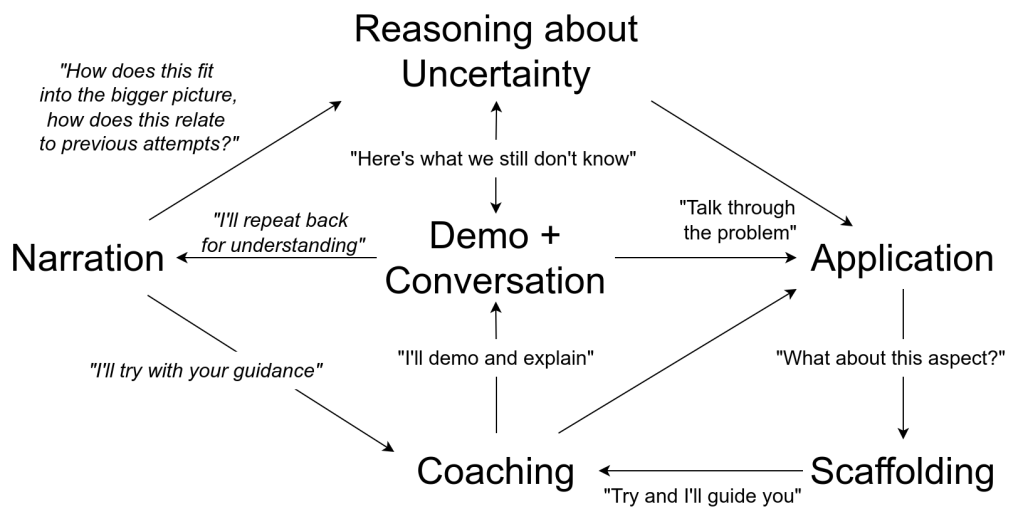
I was inspired by Mel Chua’s 7 Technique Cognitive Apprenticeship Theory to reflect on my past experience as a tutor and how similar technical communication flows have evolved in my current engineering practice. To adapt what Chua wrote, it is called “cognitive” apprenticeship because the teacher does more than teach the content: the teacher makes the metacognitive skills visible that are required to grow as a learner. This is central in the academic setting and made concrete by learning about a specific subject, unlike in a vocational apprenticeship where learning the craft is the primary goal and becoming a better learner is the side effect.

In new tech propagation, the tangible goal is to show how a novel technology can be used to build products, while the meta-goals include: communicating about and managing uncertainty, formalization of technique, connecting new work to existing bodies of knowledge and drawing from them where possible, and developing a “community of practice”. These might require changing training, test, release, and planning processes, how risk is assessed and communicated, or how user studies are conducted. Similar to how metacognition requires reflection on one’s learning processes to change oneself, the summary meta-goal of new tech propagation is to understand how the organization must change to effectively use it.

We’ll start with the flow of communication in Cognitive Apprenticeship (CA), and then show its parallels in New Tech Propagation (NTP).

Cognitive Apprenticeship

Original Document, adapted above

Most tutoring interactions start with students asking for help on something fairly specific, which is directing attention to one part of the problem space in bounding. Then I would usually ask what they know so far. This establishes the baseline of knowledge before the interaction, against which we will compare the new knowledge state at the end. This also functions as a reflection on what they’ve done already. Finally, their articulation of their knowledge or process of working through a problem removes the ‘expert blind spot’ of the instructor’s underestimation of the difficulty of a problem for a new learner.

I wanted to stay out of the direct didactic space for as long as possible, so I would then attempt to guide with questions. I tried to highlight the gaps in their understanding by asking them to consider missed cases, recall relevant principles, or push to where a governing model breaks down. This is scaffolding. Alternation of articulation and scaffolding is the ideal, because it models the process of students asking questions about their own understanding to resolve issues independently. If there is just one very specific issue with the student’s understanding, or I could cannot come up with guiding questions, I might go from articulation to coaching without scaffolding.

If guiding with questions does not get to the answer, I would then switch to guiding with direct suggestions in coaching. Here students work through problems with instructor direction. Failing this, I would demonstrate the process directly with worked examples and explain as I go: the modeling step. From modeling, I could then either ask the student to explain their own process as they work through a different problem (articulating) or to go back to the problem set or reference material (scaffolding) based on lingering issues of understanding.

The narration process was the one technique that I had difficulty integrating into my usual interactions. It is a different means of guiding with questions. Students are rarely familiar with attempting to explain as someone else works through a problem, and I’ve found is often a source of frustration because there isn’t a clear direction to the interaction. Most often it leads to coaching as is the usual step after scaffolding. In the past, I hypothesized that the reflection necessary to translate between the expert practice and their own practice is best done independently later, and would take too much time for narration to work within the context of a tutoring interaction.

Finally, the student reflects by comparing the state of their content and process knowledge before and after their interaction. I had shown how to ask questions and work through problems, and they might implicitly compare this with what they had done. I might also explicitly ask for “lessons learned” to encourage this reflection.

New Tech Propagation

Presenting a novel technology to others with the aim of integrating it into new applications requires many similar interaction patterns. However, unlike CA in an academic setting, NTP builds upon a network of communication with a presenter-peer relationship in place of teacher-student. Instead of a single tutoring session, these interactions unfold over weeks or months of attempted tech integration.

The core interaction is demonstration of the new technology and conversation with peers about its capabilities by the presenter which includes the “Modeling” and “Bounding” modes above. The most natural progression is to have peers attempt to use it by direct practice in “Application” which takes the place of “Articulation”. Hints are provided with Scaffolding which then leads to Coaching – attempted usage with direct supervision, which may return to Demo + Conservation. These interactions are all fairly similar to CA.

Narration takes on a new meaning because the peer may have knowledge that the presenter does not. The narrating peer attempts to describe his understanding of what the presenter is doing, which may include issues that the presenter does not see, connections to other fields, or past attempts to solve the same problem.

For example, suppose a computer vision team were evaluating “event cameras” for “camera traps” to capture images of Antarctic wildlife. Here “Alice” is the presenter and “Bob” is the reviewer who begins by narrating the proposal.

Alice: Event cameras differ from traditional cameras in that they only output changes in observed light for individual pixels instead of light received during an exposure window for all pixels, which makes them potentially well-suited to capture low-frequency events with large amounts of movement in the scene. They have the benefit of lower power consumption, which would conserve battery life of field-deployed camera traps, which means we can operate them for longer and justify the cost of more remote deployments.

Bob: I’ll repeat back to make sure I understand. You are proposing to move to a different system of image capture and animal detection that only responds to changes in pixel intensities with the intention of preserving battery life. In your view, by aligning the pattern of processing data with most valuable data, we have a more purpose-driven system. The claim is that power consumption would decrease because instead of processing all frames, we would process only the most interesting data. Is that correct? If so, how do we know that our power consumption would actually change?

Alice: Yes, that purpose-alignment and battery life are the proposed benefits. We can simulate this behavior in the lab in an end-to-end test by setting up a monitor in the front of an event camera and the baseline conventional camera system. Then, we can replay data we have received from the field that has a low frequency of animal movement events and monitor power consumption over time.

Bob: That sounds reasonable to validate the power consumption claims. Do we know that we have explored other possible optimizations to improve battery life? Would the event camera give the same quality of data as the conventional camera? How do we know that we will capture all of the same events?

Alice: Separately from the battery life test, we can compare the behavior of the event camera and the conventional camera through a simulation of each as image processing algorithms on our existing data set to get the precision and recall of detected events.

Bob: Is our existing data set biased because it has been captured with conventional cameras? How well will we be able to simulate the effect of using these event cameras instead? What does a pixel reading from an event camera really mean in comparison with a conventional camera?

Alice: Because our existing cameras capture at 30 FPS, and the responsiveness of event cameras is much faster, we cannot make perfect comparisons between the two platforms using our existing data. Event cameras can respond within microseconds. But the sum of all pixel change events that would happen between two frames is probably approximated by the inter-frame diff. We can validate this with a new data set of a side-by-side comparison of the two camera types in a single field study.

Here, Alice presents the idea, Bob starts by repeating it back to ensure understanding and tries to find the limits of what is currently known about event camera technology. Bob is pushing to learn how the two camera types will be compared. Alice recognizes Bob’s focus and responds with design of experiment proposals. To further the ‘tech propagation’ Bob could then create the detailed experimental design (Application), which Alice would review. Bob’s design would give Alice the opportunity to Scaffold or Coach about anything Bob missed about event cameras.

Either party could have chosen to move to discussion about the cost of the two types, more specifics about the gains in battery life, the number of different providers of these types, how durable they are in the field, the relative difficulty of developing image processing algorithms for event cameras, etc. It is not critical to touch on every aspect during the “Reasoning about Uncertainty” and it may be better to move to Application on the most important topics first.

Internally, Bob may be thinking about the right way to store the new streams of data from event cameras, if they will be queryable in the same way, or if the change in source data will allow the animal experts who receive the images to distinguish between different polar bears. Alice may be thinking about the long-term sustainability of this camera system because it is less commonly employed. By cycling between the different “Cognitive Apprenticeship” techniques, Alice and Bob can accelerate the communication of these unstated ideas. Each element of the cycle advances the technical evaluation and also prompts reflection on how their organization would have to change to support it.

Modularity in Curriculum Design

In the land of Surricula every youth must hear the sagas of stories from the sages before going out to the shore to fight the sea-goblins that dwell there. The sages inherited the sagas from their own elders and added their own twist to each story. Some stories depend on previous ones that others tell. But the sages rarely listen to the latest stories told by the others. The youths often lose sight of how they all fit together. Sometimes the sages meet to divide the science of fighting sea-goblins into better sequences of stories, or to add or subtract some, but once they do, they usually let each member decide for themselves how to tell them. Some sages even freestyle their stories and don’t write them down. A reform movement of sages calling themselves the Ceruleans decides that it is time to show the connections in the sequence by having multiple sages tell related interwoven stories – for example, about the history of the sea-goblins and biology of the dunes on the anti-goblin berms. The star Ceruleans tell compelling stories, but even among the Ceruleans, few want to retell the ones that others came up with in the same way. It takes a great deal of effort and skill to compose these interwoven stories, and the benefits are subtle – only visible in the long term success against the sea-goblins. Can these new stories scale beyond the stars?

Modularity is the principle of formally defined functional encapsulation. Components, called modules, perform specific functions with defined patterns of interaction with other components so that: they can be used in larger systems without requiring the system designer to reason about the deep internal details of how each function is accomplished (Decomposition), they can be redesigned and swapped in the place of other components that obey the same modular interface (Interchangeability), and the performance of each function by a module does not interfere with that of others (Closure). Modularity is a foundation of effective engineering because it allows for subdivision of work into smaller tasks that are easier to reason about and can be given to different people, for future improvements to the specific functions without breaking the behavior of the entire systems, and for components to be reused in any system that requires the same function.

Are these benefits of modularity specific to engineering, or can they also be applied to education? Are the Ceruleans right to argue that an excessive focus on modularity actually works against comprehensive understanding of the subject matter? After all, decomposition tries to break large problems into smaller pieces that do not require systemic comprehension. A completely modular curriculum can be disjointed, especially if it is merely “subdivided” into different courses without clear definition of the expected outcome and the place of each course in the broader sequence. At its worst, the curriculum becomes broken into different fiefdoms over which various instructors have control without a clear picture of the whole.

In place of the traditional model with courses as the core modular units, we argue it is better to think of education, and software engineering education in particular, as a fabric of interwoven disciplinary threads with explicit dependencies between the concepts and skills in the sequence. For example, within Discrete Math, the concept of a partial order is the basis for any algorithmic understanding of executing a collection of calculations with chains of dependencies which arises in Data Structures and Algorithms. This and other such dependencies should be stated as explicit linkages in the curricular fabric.

By making concepts or skills to be the base modules, curriculum designers have the freedom to innovate in small pieces by improving individual lectures, readings, problem sets, or project assignments, while also being able to compose such modules into courses and then into disciplinary threads. While there may be many disagreements about the proper content of a Data Visualization course, it is much easier to communicate about one concept such as small multiples and what should be the module’s “contract” or mark of success for its skillful employment. Then content creators are free to disagree about the right way to teach this skill and iteratively improve on its delivery. This incremental improvement is especially valuable in software where the state of the industry constantly changes.

Contra the Ceruleans, Surricula‘s sagas need openness and documentary rigor to enable such improvability more than bespoke interdisciplinary stories, which we will explain in greater detail in the next posts.

An Open Software Engineering Curriculum Introduction

Technological civilization depends on engineers who can think creatively, work on teams, design experiments, build new products, support existing systems, talk to users, and contend with questions of the proper use of technology in society. How can people with technical talent and interest learn all of these skills? Does this learning need to happen in a traditional college setting? Could it happen elsewhere, or continue throughout one’s life? How can we make such learning accessible to as many people as possible?

This “Open Software Engineering Curriculum” is an iterative approach to answering all of these questions within the domain of software engineering. In addition to the core knowledge of computer science, it aims to set out the professional skills required to succeed as an engineer. A large part of this will be the curation of existing resources with new content developed as necessary. This will draw from my experience at Olin, at Amazon, and own personal reflection. In particular, this effort aims to contribute to Olin’s “revolution in engineering education” by explicating its mostly unwritten theory and comparing it to what is needed in practice.

Envisioned Outcomes

Who is the “whole new engineer” (WNE) described in Olin’s vision documents?

In my own formulation, the WNE:

  1. Has competency in all stages of the product life cycle, which we call “Explore, Learn, Conceive, Design, Implement, Operate“.
  2. Works to improve the well-being of the product’s users and society.
  3. Understands management of a venture or business and how engineering fits into the advancement of its goals.
  4. Works effectively in teams.
  5. Is a capable communicator in writing, oral presentations, and documentation.
  6. Reflects on how engineers learn and develop their skills, and understands engineering as a discipline that is open to improvement.

Who could become this WNE? It should not just be high school students who enter a Bachelor’s program designed with these goals in mind. It ought to be anyone who wants to develop an engineering mindset, whatever their state of life.

Principles

To promote this, OSEC as a project will be:

  1. Accessible: All internal works will be in the public domain. External works referenced as part of OSEC should be accessible as digital files, should preferably be in the public domain or under permissive licenses, and if not be low-cost.
  2. Complete: Completeness of content is more important than avoiding repetition.
  3. Iterative: The content will improve over time. It is more important to cover all relevant topics adequately and solicit feedback for improvement than to make each segment perfect on first publication.
  4. Reviewable: Resources will be structured to allow for in-line commentary and easy response.
    • As of 2023/09/24, this is using the in-line commenting feature on the constituent documents, attached at the end. This will evolve in the future.
  5. Curated: External content referenced as part of OSEC will be reviewed thoroughly and contextualized within the broader project. Every piece of content will have explicit justification for its inclusion. This will be most of the effort.
  6. Shareable: The internal OSEC content will be distributable as a single file by minimizing resource size and using common formats, or as a repository.
    • This content will likely move to github eventually.
  7. Opinionated: While it will integrate content and feedback from many sources, this OSEC as a compendium will be one person’s work to maintain coherence. Its placement in the public domain will allow extension or remixing by others as they see fit.

OSEC’s three main parts will be a curated software engineering curriculum, a collection of essays on engineering practice and how to develop a learning community outside of the typical structure, and meta-commentary on the design of such a curriculum and pedagogical theory.

Contents

  1. Pedagogy and Curriculum Structure
    1. Direct Instruction, Do-Learn, and Crystallized Engagement
    2. Mindset of the New Engineer
    3. The Engineering Toolbox and Toolshed
    4. The Company Cohort
    5. Modularity in Curriculum Design
    6. The Flow of Cognitive Apprenticeship and New Tech Propagation
  2. Engineering Practice
    1. A Generative-Evaluative Design Meeting Style
    2. The 80/20 of Team Cohesion
    3. Review and Approval Systems
    4. The Engineering Design Sequence
  3. Core Content
    1. Curriculum Overview

An Open Software Engineering Curriculum Overview

What is the right curriculum to achieve the envisioned outcomes for software engineers? I propose that such a curriculum has four interwoven disciplinary threads with the desired professional skills and mindset integrated into their courses. The four threads are:

  1. Computers as Formal Systems: Programming languages are unlike natural languages in that their statements mean exactly one thing. Any piece of code is a definite specification of operations or “instructions” that the “processing units” of a computer will perform. Instructions are simple arithmetical operations and movements of stored data, but they can be built up into extremely powerful tools. This thread starts with treating a computer like a ‘big calculator’ to crunch numbers to understand the behavior of physical systems in “Modeling and Simulation”, develops with the systematic construction of software, and reaches its completion with the theoretical foundation of what computers can do in “Foundations of Computer Science”.
    1. Modeling and Simulation, Software Design, Discrete Math, Data Structures and Algorithms, Computer Architecture, Software Systems, Databases, Foundations of Computer Science.
  2. Computers for Mathematical Analysis: Engineers work with data, and data from the real world is noisy! Processing large volumes of data requires computers. Engineers need to learn how to use computers to collect data, manipulate it, draw inferences from it, and present it to people in a way they can understand. This thread begins with a foundation in Probability, Statistics, and Linear Algebra, progresses through Machine Learning (automated pattern recognition) and serves as the basis for the mindset of experimental design.
    1. Modeling and Simulation, Linear Algebra, Probability and Statistics, Machine Learning I: Tabular, Data Visualization, Machine Learning II: Computer Vision, Computational Robotics.
  3. Computers in Integrated Products: We can use computers not only to do math, but also in embedded physical systems that do things in the real world. Once we physically deploy complete systems, the fun of integration challenges begins! This is a sequence of integrated hardware, electrical, and software projects that cultivates the mindset of building full products with computation at their core.
    1. Real World Measurements, Fundamentals of Robotics, Computational Robotics.
  4. Human Context of Engineering: Engineers build things for people with other engineers. How do we design the right products for our users, along with them? How do we communicate our mathematical analyses and experimental results? How do we learn from and teach others? And then how do we integrate all of our technical and interpersonal skills into human organizations that build things together? This thread has several courses explicitly within it, but permeates through the curriculum.
    1. User-Oriented Design, Data Visualization, Teaching and Learning, Venture Management.

While these threads are presented distinctly for clarity of communication, the knowledge and skills they impart are all tied together. This particular example of an “Open Software Engineering Curriculum” (OSEC) has eight “phases” that could roughly correspond to eight semesters, or eight increments of independent study. With eight semesters, there is plenty of room for “distribution requirements”. Each pair of phases (I and II, III and IV, etc.) could be done simultaneously to compress the sequence into two years without other courses included. Each pair contains a course with a substantial team project, highlighted in green. There are seven underlined courses that lend themselves to the creation of projects that are suitable for a “portfolio”.

As described in the “Structured Exploration” and “Mindset” chapters, this curriculum is designed to promote a proactive approach to learning, teamwork, user orientation, and long-term systems thinking. These themes are introduced early in the sequence so that they can be cultivated over time.

OSEC, as a project, is mostly a work of curation and “restyling” existing content to better promote the proposed outcomes. Almost all of the named courses correspond to well-known pedagogical modules which are listed as references. These references will be incrementally reworked and further curated. I have intentionally “tied” certain modules together in the sequence that ought to be taught within a single block. Because software engineers are primarily practitioners, learning of math is tied to application within this curriculum.

The intention of this OSEC is to present a comprehensive and explainable course sequence. Compare this to the MIT Computer Science and Engineering requirements and outcomes documents. Instead of merely listing the content, this is meant to explain how it all fits together.

Courses

  1. Real World Measurements: Arduino C:
    1. Imagine a “weather station” that monitors wind speed, rain, humidity, sunlight, etc. and is physically deployed. To put together such a weather station requires integration of microcontrollers and basic circuits, as well as simple mechanical design to enclose it and make it resistant to the elements. The physical system must be maintained through time, over months or even years, and can be progressively improved in response to problems. Once it is deployed as a system and reporting data, the data stream can be processed and uploaded to the cloud. Visualizations can be built on the data stream as a simple website. The data set presents opportunities for analysis and predictive modeling. Multiple stations can communicate as a mesh network. Starting from even a simple measurement device, there are many avenues for problem-based technical depth within software engineering across the product life cycle. The practice of physical and software maintenance within this project helps to prevent a mindset in which “everyone wants to invent the future, but no one wants to be on the future’s on-call rotation”. All of the technical features are built upon the continuous proper functioning of this device and data pipeline.
    2. This is the central project within this course, but there can be other kinds of sensor integration possible. Its location at the beginning of the curriculum is to introduce ideas of system integration (HW, EE, SW) and long-term maintenance. For the sake of simplicity of management and ensuring good learning for each student, this is not naturally a team project.
    3. Budget for Arduino, servos, sensors, lights, wires – roughly $200.
    4. Data can be used as the basis for future courses: Modeling and Simulation, ProbStat, Machine Learning, Data Visualization.
    5. Emphasized Stages: Explore, Learn, Design, Implement, Operate
    6. References:
      1. MIT Introduction To Electronics, Signals, And Measurement
  2. User Oriented Design
    1. Students can learn how to care about long-term effects and sustainability of products for the people using them simply by working with them over longer periods of time. Olin’s “Engineering for Humanity” is an introductory design course that pairs students with seniors and has them try to solve problems that they face, often centered on negotiating the physical environment. Working with seniors in this way has many advantages: physical objects are often not easy for them to use, and so there are plenty of opportunities for assisting them. Solutions can be inexpensive. Seniors are often overlooked, generally have a lot of free time, and are happy to talk to young people who want to help them, so they are an ideal user group. By extending this engagement beyond a semester-long course and doing long-term support for these projects, students can gain an appreciation for lasting impacts on users as well as technical sustainability.
    2. This is located at the beginning of the curriculum to plant the seed of thinking about impact on the end user. Some students enter into engineering just wanting to create something that is cool, and not on the end result, or might be hesitant to engage with people. Seniors naturally want to talk to them, so they are a great group to start with.
    3. Team Project, Portfolio Project
    4. Emphasized Stages: Explore, Conceive, Implement, Operate
    5. References:
      1. Olin Engineering for Humanity
      2. MIT Principles And Practice Of Assistive Technology
  3. Modeling and Simulation, Probability and Statistics, Linear Algebra
    1. Topics: Weather Forecasting, Stocks and Flows, Simple mechanics and thermal simulation, Introduction of datasets that require probabilistic modeling, Introduction to Bayesian and Frequentist statistics, Monte Carlo Methods, Transformation of physical systems through time, Introduction of Linear Programming, Optimization Approaches.
    2. Emphasized Stages: Explore, Learn, Implement
    3. References:
      1. MIT Probabilistic Systems Analysis And Applied Probability
      2. MIT Introduction To Probability And Statistics
      3. MIT Linear Algebra
      4. MIT Modeling and Simulation
      5. MIT Inference of Data and Models
      6. MIT Modeling Environmental Complexity
      7. Olin Quantitative Engineering Analysis
      8. Olin Modeling and Simulation
  4. Software Design and Discrete Math
    1. Methodical design of software and learning the mathematical basis of software systems. Object Oriented Design, Modularity within software projects, Introducing time and space complexity analysis. Building a video game as a group to introduce collaborative SW development, simple user experience testing, Model View Control design pattern.
    2. Discrete Math is often mistakenly taught after the introductory software “design” course, but this is wasteful because all of its concepts are naturally included in learning the theory of software. Software projects can be chosen to illustrate different ideas within Discrete Math. Formal thinking and constructing proofs of mathematical relations introduces students to the idea of computers as mathematical symbolic manipulation machines instead of just tools. It would be wrong to start with the theory and postpone “building things with computers” until after the math.
    3. Team Project, Portfolio Project
    4. Emphasized Stages: Explore, Learn, Design, Implement
    5. References:
      1. MIT Math for Computer Science (Discrete Math)
      2. MIT Software Construction
      3. MIT Creating Video Games
      4. Olin Software Design
  5. Machine Learning I: Tabular and Data Visualization
    1. Analysis of datasets and “statistical learning” leading to close examination of the data and its distributions. Emphasis on communication to people in general interest technical writing alongside purpose-driven visualizations. Making a simple website for these artifacts. Understanding how pattern recognition can be automated. Can build upon the weather station data. Creating ML models of physical processes: this is an advancement over the simpler approaches introduced in Modeling and Simulation / Linear Algebra. Includes (review of) necessary Calculus concepts. “Citizen Data Science”: using data visualization and modeling to present an argument about some topic of public interest. This is an exercise in public communication through data. Accuracy of analysis and presentation is key.
    2. Portfolio Project
    3. Emphasized Stages: Explore, Learn, Conceive, Design, Implement
    4. References:
      1. MIT Intro to Machine Learning
      2. MIT Visualization For Mathematics, Science, And Technology Education
      3. MIT Machine Learning For Healthcare
  6. Data Structures and Algorithms
    1. Formal analysis of computational processes.
    2. Emphasized Stages: Learn, Design, Implement
    3. References:
      1. The Algorithm Design Manual, Steven Skiena
      2. MIT Intro to Algorithms
      3. MIT Design and Analysis of Algorithms
  7. Fundamentals of Robotics
    1. Building integrated mechanical, electrical, and software systems in a team. Characterization of motors. Build a simple robot that moves in the world in response to sensor input. After this course, students are well-posed to mentor a high school robotics team.
    2. Team project, Portfolio project
    3. Emphasized Stages: Explore, Learn, Design, Implement, Operate
    4. References:
      1. Olin Fundamentals of Robotics
  8. Teaching and Learning
    1. Starting in phase V, transition from foundational learning to specialized learning. Engagement with high school students or earlier learners of this curriculum in a teaching or mentoring capacity. Mentoring is a core engineering skill for the sake of organizational sustainability and learning how to communicate to more junior people is a completely different mindset from communicating to professors who know more about the subject. After the “Citizen Data Science” from “Data Visualization”, communication deepens by teaching others technical subjects.
    2. Emphasized Skills: Communication, Mentoring, Reflection on Process of Learning
    3. References:
      1. How Learning Works” (Susan A. Ambrose et al.)
  9. Computer Architecture
    1. Working up from logic gates and arithmetic logic units to a complete simple computer in simulation. Instruction sets and Assembly language.
    2. Emphasized Stages: Learn, Design, Implement
    3. References:
      1. MIT Computation Structures
      2. MIT Computer System Architecture
  10. Machine Learning II: Computer Vision
    1. Classical computer vision techniques, Convolutional Neural Networks, Transformers. Data augmentation. Object Detection, Segmentation. Animal identification in the wild, which can be integrated into the “weather station”, then relate presence of animals to environmental conditions.
    2. Portfolio Project
    3. Emphasized Stages: Explore, Learn, Design, Implement, Operate
    4. References:
      1. MIT Intro to Deep Learning
  11. Software Systems & Databases
    1. Introduction to: Operating Systems, Web Servers, Networks & Distributed Systems, Database Management, System Performance Analysis. Emphasis on detailed design reviews of peer’s artifacts.
    2. Emphasized Stages: Explore, Learn, Design, Implement, Operate
    3. References
      1. MIT Computer System Engineering
      2. MIT Operating System Engineering
      3. MIT Performance Engineering Of Software Systems
      4. MIT Database Systems
  12. Venture Management
    1. How do we integrate all of our technical and interpersonal skills into human organizations that build things together?
      1. As of 2023/09/21: Open question on whether this should attempt a practical component of operating a business. I am more skeptical of this because it is difficult to make actual business operations self-contained within the scope of a course and still be a meaningful management experience. Current plan is that this would primarily include the curation of case studies and readings on management with exercises in opportunity assessment via interviewing hypothetical users and creating a business plan.
    2. References:
      1. MIT Patents, Copyrights, And The Law Of Intellectual Property
      2. MIT Engineering Risk-Benefit Analysis
      3. MIT Nuts And Bolts Of Business Plans
  13. Computational Robotics
    1. An integrated robotic system navigates in its environment to accomplish tasks based on image input. SLAM. Computer vision in the wild.
    2. Team Portfolio, Portfolio Project
    3. Emphasized Stages: Explore, Learn, Conceive, Design, Implement, Operate
    4. References:
      1. Olin Computational Robotics
  14. Foundations of Computer Science
    1. Theory of Automata, Turing Machines, Computability, Functional Programming. Standard approach would be to focus solely on the proofs. Intention in this course is to actually implement ‘automata’ in OCaml.
    2. Emphasized Stages: Learn, Design, Implement
    3. References:
      1. MIT Automata, Computability, And Complexity
      2. MIT Theory Of Computation
      3. MIT Information Theory

The Engineering Design Sequence

What are the different kinds of design meetings you might encounter? The Brainstorming meeting is one of the most important, but being prepared for all of the different design meetings and processes in the product lifecycle will help you anticipate the twists and turns of professional life.

1. Requirements Gathering and Inception: In this meeting you will define the problem statement: Who is the customer? What does the customer need? What is the timeline for delivery? The answers to these questions will evolve over time, but they must start from somewhere. This is the prompt for the design ideation meeting.

2. Design and Ideation Meeting: This is the subject of the previous letter. Every member of the team prepares for this meeting based on the initial profile of the customer discussed in the Requirements Gathering meeting. This meeting is within the team, and should be at most two hours long to start.

3. Design Preview: The Ideation meeting produces a few candidate designs that are worthy of further discussion. The “Design Preview” is a written rapid summary of these designs that is sent out to the broader engineering community within the venture. This allows a wide range of people outside of the immediate team an opportunity to offer high-level feedback on the various ideas. Other engineers can here suggest different technologies that may have been missed or mention unforeseen pitfalls. This Preview should be published the same day or the next day from the Ideation meeting, and the commenting period may be about a week long. The purpose of this process is to prevent the team from investing too much in the development of specific designs before many people have had the chance to mention problems that may have been overlooked. Distribution of these ideas and soliciting feedback also builds a more closely integrated engineering community.

4. High Level Design Review: A synchronous review of a design document that covers all of the major aspects at a summary level. The sections will likely include:

  1. Problem Statement, Customer Needs
  2. Major design constraints
  3. A component diagram of the most important modules of the system
    1. This shows for the happy path how the different modules interact.
  4. What are the APIs?
    1. What is the cost per million operations for each of the APIs? What are the load projections for the first year? In five years?
  5. What cloud services will be used, in public offerings (such as AWS) and internal dependencies?
  6. How do the servers scale? Could the service use a cellular architecture?
  7. Monitoring, logging, and archival strategy
  8. Security strategy
    1. What is the most sensitive data that this can handle? Will any safety-critical processes be impacted if this system is compromised?

The Design Preview was a sketch of the product and this is a full picture. It should be possible to read this document in less than 30 minutes so that there is another 30-60 minutes in the meeting for discussion and review of comments. There should be a smaller set of reviewers for this HLD who have built similar services but are on different teams.

The HLD will not be a complete specification of the system. It serves as a starting point for understanding how all of the pieces fit together. The designers must begin to consider each aspect of the system to write the HLD, and the reviewers have a chance to offer guiding feedback on these choices.

5. Low-Level Design Review(s): This is an asynchronous review of the most important algorithms, database schemata, call & retry patterns, state machines, and timing diagrams of the service. These include the unhappy paths in the system, such as how various dependency failures will be handled. The algorithms should be included as pseudo code. These design documents should allow line-by-line commenting.

Engineers will be able to work from this LLD to create individual stories (discrete units of implementation). Because of the level of detail and effort required to make this design, it is not necessary for every component to be complete before starting the asynchronous review. For example, there might be a single review of the database schemata, which could even have its own meeting.

6. Invalidated Assumption Response Meeting: “No plan survives first contact with the enemy”. In the practice of engineering, the laws of nature do not act adversarially as a military foe does, so plans survive longer, but are never perfect. All designs make assumptions about how the world works, whether that be about customer behavior, the structure of internal service dependencies, or the average runtime performance of an algorithm based on some distribution of data. Inevitably, something goes wrong. One should be psychologically prepared not only to adapt to these invalidated assumptions, but actively pursue evidence for their confirmation, with priority given to those that are the least certain.

In this meeting, the engineering team brainstorms options for dealing with these invalidated assumptions. This might require rewriting large portions of the service again, depending on the severity of the problem. Engineers must start from a reconceptualization of the product: if we knew at the beginning what we know now, how would we have designed it? Because of the demands of delivering the product, it might not be possible to completely rewrite everything, or start from scratch. But if you start from the ideal state and work towards what is feasible within the project timeline, you will come to a better solution than if you attempt to make the quickest patch to the design without an idea of how to do it the right way. The new conceptualization will also serve as a starting point for a re-architecture when the service encounters scaling challenges.

As the engineers on a team become more familiar with a design space, for example how to build customer-facing cloud services using AWS, their implementation speed will increase. Thus they will be more willing to discard outmoded components because the sunk cost fallacy will be less attractive. Keeping a level head in the face of major design changes that become necessary mid-way through implementation is an important part of being an effective engineer.

7. Scaling Challenges Response Meeting: Congratulations! Your product delivered clear value for the customer and you dealt with changing requirements effectively. It is so successful in the limited roll-out that management wants to deploy it everywhere, ASAP. You are ready for that, right?

While you may have designed your service to scale horizontally rather than vertically (such that increased load just requires more servers and not more powerful servers) you will probably find that adding new customers exposes new invalid assumptions, or reveals scaling processes that may require expert human input, such as customer-specific configuration. These processes need to be either automated, pushed to the customer (in the case of configuration or fine-tuning), or delegated to a deployment team. Accepting them as a recurring cost to the engineering team will not work as a long-term strategy. If you delegate it to deployment engineers, you will have to create training materials for them and prepare to spin up such a team, if you do not already have one. If the customers can be taught how to set their own configuration, then you may seemingly get that “for free” regardless of scale, but you risk compromising the customer experience and open the engineering team to high urgency requests from them. Automating such tasks is ideal in the long term, but may take too long to design for the current needs. Or, a new load on your service may also reveal hidden super-linear scaling behaviors such as synchronization required among all hosts or within some internal database or cache.

Prevention of these issues during the design phase beats trying to fix them in-flight, but despite your best efforts they will likely still arise. In this meeting, you will revise your growth projections for your service that you made in your initial HLD. You will now have concrete data for the performance of your service in production which you can use to make more confident estimates of resource needs. Your team will have a list of non-automated tasks and super-linear scaling behaviors that arose during the initial deployment of your service, and you will record all of them in a common register. The resolution of each issue will have a cost in some combination of automation (non-recurring engineering), deployment management (per-customer one-time cost), continuous support (recurring support engineering cost), and server costs (operational costs).

8. Support Plan Meeting

Every customer support ticket, service outage, scaling failure, manual maintenance action, and explanation of the service behavior to management imposes a potentially recurring cost to your team to sustain the product. The engineering team must work to automate such actions where possible and otherwise standardize the team’s response through the creation of “runbooks” or protocols. These runbooks are guides to diagnosing and addressing common issues, performing maintenance, or answering frequent questions. They will often include case studies of actual support tickets. When updating these runbooks, the team should have a live review so that each member can ask questions or share additional information about related issues that may have arisen during an on-call rotation. These discussions naturally create statements of requirements for redesigns that will prevent or automatically remediate such issues.

9. The Quick Fix: Acknowledged Tech Debt

In an ideal world, every discovered design flaw would lead to a rewrite of the service from first principles. However, in practice that cannot happen. All products, and especially software services, have a limited lifespan and it is sometimes appropriate to make a quick fix that isn’t pretty either in the expectation that it will be resolved at a later time, or that it will persist until the service is deprecated. The purpose of this as design meeting is to have common acknowledgement of suitability of this fix, review the documentation of its shortcomings, and sketch what would have been the right design if the team were starting from scratch. These sketches also seed the design of the future generations of the service.

10. Transmission and Inheritance

Changing ownership over a service would ideally look like a baton pass, but in practice it is moving into someone’s fully furnished house and slowly discovering all of the infrastructural problems with it.

As no one’s career should be tied to a single product, no product or service should be indefinitely owned by a single person or engineering team. The most natural progression is for engineers to move between teams every 1-5 years.

This rotation serves to:

  1. Bring fresh ideas, perspectives, and variety of technical expertise applied to specific problems,
  2. Reduce burn out by having people work on a variety of projects,
  3. Increase support redundancy and reduce siloization of efforts,
  4. Force regular maintenance of documentation and test its comprehensibility while onboarding new members to a problem.

This comes at the cost of:

  1. The effort of teaching new members and their effort in learning,
  2. The time to build new working relationships between engineers, product managers, customers, and other engineering teams.

If rotation is done too soon, engineers may not have had time to develop the deep knowledge of the problem space necessary to comprehensively evaluate designs. Working in one domain on a variety of different projects can enable engineers to see how problems relate and innovate on how to solve many things at once. In practice, however, premature rotation is rare because the cost of knowledge transfer is usually rated highly, and organizational inertia limits how frequently it is done.

The engineer rotating off of a project is responsible for finalizing documentation and summarizing the lessons learned during his tenure. He should write an overview of ongoing work, planned work, and research questions, and a retrospective of recognized shortcomings of the team’s designs and products. These should be reviewed together with the team.

A new engineer should start with an asynchronous review of the team’s documentation. A first reading is to become familiar with the shape of the domain, and a second is to make in-line comments for specific questions. Then one tenured engineer on the team takes responding to these comments and updating the holes in documentation as a task. They then have a live meeting to review the questions and give an introductory implementation task to the new engineer.

11. Deprecation

The memories of praises won are long-gone now, only a pile of technical debt remains. Customer needs, service dependencies, and even design paradigms have changed. Starting over is far more attractive than continuing to repatch the holes in the ship. It’s time to deprecate the service.

Deprecation, as a process, often requires its own design or execution plan. You want to ensure that your customers have a seamless transition to the next generation. In software, this typically means that both services are running simultaneously and the new one starts with a limited roll out. If the boundary between the service and the rest of the world is clean, it may be possible to simply reroute request traffic to the new one. However, if there are any unfortunate couplings such as database access it might not be that easy. As each customer switches, you may even discover load-bearing bugs or undocumented behaviors in the old system that were not replicated in the new design.

The deprecation execution plan should be reviewed both within the team and with other relevant engineering and customer stakeholders. The plan will likely include:

  1. Documentation of any changes in customer-facing behavior with the new generation.
  2. A plan for validating the migration of each customer.
  3. A schedule
    1. for communication with customers
    2. for each operation within the deprecation, such as an initial migration of customer records to a new database, not allowing creation of new entities, then not allowing updates of existing entities, final migration of existing records, validation of the migration, blocking reads of the existing database, and final deletion / archival of records in the old database.

A Generative-Evaluative Design Meeting Style

What is the right way to run a brainstorming or design ideation meeting? What comes naturally to most people is to sit in a circle and freely shout out ideas until one gets the approval of a few other members, with critiques of each interleaved with their generation. But there are better ways motivated by a desire to solicit input from all members of the team, promote information sharing, and deliberately form and consider ideas against agreed-upon criteria. Here we present a “Generative-Evaluative Design Meeting Style” with justification for each step of the process. Effective meetings don’t happen by chance, and by intentionally structuring them and reflecting on what works, we can achieve better results.

“A Generative-Evaluative Design Meeting Style”

  1. Prior to the brainstorming meeting, the group should have a high-level discussion of what the customer or end user values.  This could include things like safety, frugality, convenience, simplicity in user experience, similarity to existing tools or designs, etc.  The purpose at this time is not necessarily to have definite agreement on each of these values, but to prompt everyone to get into the generative mode of thinking by adopting the perspective of the end user.  
  2. Ideally before the design meeting, present the question or design challenge to the group so each member can begin thinking of ideas and doing research.  If this is not possible, start the meeting with 10-15 minutes of “quiet time” in which everyone writes down his or her ideas on paper or on sticky notes independently.
  3. After that time, everyone selects any number of ideas to share with the group from those written down.  Everyone selects at least one to share.
  4. One person is chosen to be the facilitator of the discussion.  This person should ideally be the most junior member of the group, or the role may rotate among members.
  5. Going in a circle, each member introduces one idea in a 1-5 sentence explanation.  There is no debate or evaluation of the proposal at this time during the sharing process.  Only the most basic clarifying questions may be asked.  The facilitator writes each idea on the whiteboard with a title and a short summary.  The fact that the idea is written on the whiteboard by the facilitator helps to build distance between the proposer and the idea itself.
    1. It is common and expected that some ideas will overlap in this process, which is no problem. The presenter of the idea that overlaps may decide if it is worth listing separately, as a variant to an existing idea, or not at all.
    2. Everyone goes in a circle (again with each person contributing at least one idea) until everyone has exhausted ideas to share.
  6. After all ideas have been shared, the group uses “approval voting” not for ideas to pursue towards design, but for which should be discussed further.  All members vote by raising a hand for each idea they consider to be worthy of discussion, and each person can vote for any number of ideas.  Members should vote for an idea if it seems viable or if it would enrich the group’s discussion.  The number of votes is recorded for each idea.
  7. The ideas then are put up for further explanation in the order of the number of votes they have received.   It is not necessary to discuss every idea.  The group may use its judgment for which ideas should be put  up for longer discussion. The presenter of the idea gives more explanation as desired from the group, and answers questions, gives clarification, etc.  Still, at this time, the focus is on exposition of each idea and not evaluation. During this step, others may come up with more ideas, which is to be encouraged, and may add them to the queue to be discussed.
  8. Once everyone has had sufficient opportunity to share ideas, the group creates a decision matrix of the ideas that have generated the most interest and seem most plausible with the values of the customer or the design as the criteria for evaluation.  This is ideally done on the whiteboard. At this point, discussion is opened up for full critique of ideas against the evaluation criteria.  More criteria may be added, and the group may collectively try to refine the means of evaluation, e.g., how to judge the simplicity of a user interface.
  9. The group does not need to make a decision on the design choice during this meeting.  The appropriate outcome of a brainstorming meeting in this style is a list of action items, such as the creation of experimental plans to compare designs, calculating the cost of each idea, mathematical analysis of system dynamics under the different designs, etc. that would inform the decision process for the top proposals.  Or, the group may decide that none of the ideas would satisfy the needs of the problem, adjourn to conduct further research, and repeat this brainstorming process.

This meeting structure may seem strange or unfamiliar, but has a variety of benefits over a “free style” or unstructured brainstorming meeting.

  1. Separating the generative and evaluative phases:
    1. This is an important psychological benefit.  Without wading into questions of why this phenomenon exists, there seems to be two different intellectual modes – one generative, creative, imaginative and another analytical-critical.  Everyone should ideally stay in the “flow state” of idea generation and feel free to propose things that might sound crazy, because those ideas may contain within them pointers to aspects of the problem or user needs that may otherwise be missed.  
    2. Brainstorming meetings often are impeded by either idea introduction and immediate critique, which can make some too hesitant to share, or immediate sharing of whatever pops into someone’s head, which can waste the group’s time.  By requiring everyone to write down and then intentionally share without immediate critique, this process moderates between those who are too eager and those who are too hesitant.
  2. Soliciting ideas from every member:
    1. Everyone is required to contribute at least one idea.  This helps to get a wide variety of experience (personal and technical) incorporated into the set of ideas evaluated.  Even if an idea is not selected, it may introduce a new technology, process, or design pattern to the group.
    2. This shared activity in which everyone participates helps to build team cohesion.
    3. Everyone practices design and ideation skills.
      1. Not only the most senior members should do the design.  Team design work should be collaborative.
      2. One of the junior members of the team facilitates the discussion so that he or she remains engaged.  The natural tendency is for the most senior members to have strong ideas from the beginning.  Having the junior members facilitate the meeting improves the vertical transmission of design knowledge by ensuring that the least experienced members can understand what is being proposed.  This also helps make ideas explicit and forces clear communication.  Design meetings are some of the most valuable opportunities for knowledge transmission in terms of time-density.
      3. By requiring everyone to meditate on the problem separately before sharing with the group, no one can be complacent with letting others do the design.  Then everyone can compare their own set of ideas generated with others’, which is valuable for both vertical and horizontal knowledge transmission.
    4. The requirement to write down one’s ideas with a formal process for introducing them to the group also restrains those who might take up too much of the discussion time and gives a structure to those who might be reticent or junior within the group.
  3. Approval voting of ideas for further discussion allows everyone to express their high-level evaluation extremely efficiently on every proposal.
    1. Voting for just one may obscure that some believe a 2nd best is still worthy of discussion, and each person coming up with a ranking of all ideas would take too long.
    2. It also allows the group to not waste discussion time on negative evaluation of ideas that no one wants to pursue.
  4. Separation of the idea from its creator by having the facilitator write each on the whiteboard with a title that describes the proposal instead of referring to the proposer.
    1. This helps everyone discuss the ideas dispassionately and without ego.
    2. Every idea is put in the same decision matrix, and then everyone looks at the decision matrix instead of the proposer.  This is another important psychological benefit, because idea evaluation is then framed in terms of what the customer needs instead of who is proposing it or a conflict between proposers.
  5. Once the idea is on the whiteboard, everyone can understand what has been proposed.  A common meeting pitfall is to verbally describe ideas without recording them, and then go in circles re-explaining what has already been introduced or debated.
    1. In a group of 4-8 people, it is likely that some will lose focus, and it is better that they can refer to the whiteboard rather than ask the basic questions again.
    2. The visual action (writing on the whiteboard) helps to focus attention when paired with the verbal description.
  6. Centering the critical discussion on the design criteria that were mostly decided before the meeting.
    1. This is “beginning with the end in mind”.  Everyone knows at the start of the meeting that the goal is to eventually evaluate the ideas based on these criteria.  The goal of the meeting is to decide on how to refine the evaluation of the proposed ideas in terms of experiments, research, and analysis.
    2. There needs to be serious consideration of the user or customer needs before brainstorming begins.  This helps to focus on the ideation itself during this meeting.
    3. It is expected that there might be some user values that were not explicitly acknowledged at the start, but only arise when comparing proposals.  This is a good result to have because the team improves its understanding of the customers by imagining what each proposal would do for them.  The team also moves from private judgments of the user needs to common explicit understandings by requiring framing the evaluation in terms of definite criteria.

In summary, this is not a definitive guide, but a set of suggestions for a better design meeting structure. Other structures are possible. By making this one explicit, new designs can build off of it.

Mindset of the New Engineer

What is the intended resultant mindset of this “Open Software Engineering Curriculum”? We will call it ‘Systemically Sustainable Innovation’ instead of disruption. We will develop it by examining two works: “A Whole New Engineer” (WNE) and “Rethinking Engineering Education: The CDIO Approach” (REE), and showing how ‘Crystallized Engagement’ is its formative paradigm.

Take the example of the obsolete bionic eye implant, “Second Sight” made for people without vision. The implant stimulated the retina of the patient with electric pulses based on a low-resolution separate camera feed which created a basic sensation of vision. Eventually the company went bankrupt and as devices failed, there was no possibility of replacement parts or support. Patients were left with non-functioning eye implants that complicated future medical procedures. Due to the low market size and high specialization, a secondary manufacturing process would not be financially viable, even if the designs were released. This illustrates several different aspects of ‘systemic sustainability’: The long-term technical reliability of the device was not proven. As an industrial process, low volume production and support could not achieve economies of scale. The company’s financial viability was tenuous because of a smaller-than-expected market and high costs of sales, regulatory compliance, and rehabilitation after implanting the device.

As a new product, it created a new dependence, which in turn created a new responsibility of care that could not be sustained as a system. While engineers should have freedom to innovate, they must also be mindful of the long-term implications of any new technology, which starts with its specific sustainability. Engineering education ought to foster this mindset through direct practice, which is the intention of the ‘Crystallized Engagement’ approach.

This formulation came, in part, from reflection on two recent works on engineering pedagogy. “A Whole New Engineer” by Goldberg and Somerville presents the story of Olin College and the University of Illinois’ iFoundry engineering program. Through experiential learning (Do-Learn), an emphasis on teamwork, and a focus on the joy of building, these institutions and the “Big Beacon” movement hope to bring about a cultural change in engineering education. We will contrast this with “Rethinking Engineering Education: The CDIO Approach” by Crawley et al. which presents a systematic consideration of each step of the engineering process (in their account): Conceive, Design, Implement, Operate and describes how to integrate them into the core content of engineering program. REE seeks to also weave professional skill development into these courses as a positive sum interaction instead of a time trade-off (p. 33). WNE is a vision statement for a different kind of culture in pedagogy: one that replaces weed-out thinking and competition between students with collaboration and personal development. It isn’t a how-to guide. REE is a bit narrower in its self-conception and isn’t tied to specific institutions in the same way that WNE is. It goes deeper into the methods of program development and evaluation. Both have theories of institutional change, and in particular how to move from courses based on Direct Instruction to a problem-based curriculum with projects integrated from the beginning of coursework. Neither acknowledges the other, despite many similarities and likely opportunities for the social networks of the authors to overlap.

But more importantly, neither gets the full life cycle of engineering right, which does not prepare students for thinking about systemic sustainability. As described in the previous essay, the ‘Do-Learn’ or ‘Structured Exploration’ approach to pedagogy allows technical problems to drive learning of the core engineering content. From there, projects give the opportunity to quickly plan and build prototypes that demonstrate the concepts presented within the courses. The CDIO approach, on the other hand, places a stronger emphasis on methodical Design after the initial “Conceive” phase, and also includes the “Operate” step. To operate a new product for an extended period of time naturally leads to thinking about reliability in a way that rapid prototyping does not. In “Rethinking Engineering Education for the 21 st Century” by Richard Miller, Olin’s first president, ‘sustainability’ is listed as one of the key modern challenges, but is not in the presented nine core competencies within engineering, and long-term operation is nowhere mentioned as an important part of the curriculum. Olin’s “Do-Learn” and project-based courses have what we would call Explore, Learn, Conceive, and Implement as the core steps. New problems or application areas often call software engineers in particular to learn about new domains even within the scope of a project, which means that they need intentional practice of Exploration and Learning at the beginning of any new venture. Altogether, our proposal is a union of these two approaches into the complete “ELCDIO” cycle within Crystallized Engagement. This full project cycle will take more time than the traditional project framing, but we believe it will pay off in the resultant change in mindset.

From here, we will examine the different kinds of sustainability. Engineers must first learn to get systems to work reliably, which we can call “Technical Sustainability”. There are several important obstacles to cultivation of this mindset within the curriculum. Reliability doesn’t carry the same appeal as disruptive innovation, and often doesn’t require the same level of theoretical depth that professors naturally want to impart in their curricula. When professors go to industry for technical consulting, they are usually involved at a low level of Technical Readiness because that is their comparative advantage and where their expertise is actually needed, and rarely in the reliability engineering of existing products. This can give them a skewed understanding of the future practice of engineering for most of their students. Or, they can discount reliability as something that can be learned on the job and not worth core curriculum time.

Further, the desire to cover a large body of theoretical knowledge leads to a mindset and habit of speed over quality. In school, a score of 95% is typically an A – the highest grade. In software, getting something 95% right means that the code doesn’t build, 97% right: it doesn’t pass unit tests, 98%: doesn’t pass integration tests, 99%: doesn’t deploy, 99.9%: you or someone on your team gets paged at 3 AM weeks later for an untested edge case that renders your system non-functional until you roll back the change or deploy a hot fix. In other domains of engineering, there may be design margins (for example, in load ratings of structures) to allow for error, but large margins are materially expensive. In practical engineering, you and your team need to re-do things until you get them right and not merely move on to the next project. Project-based learning often turns into making something technically interesting that barely works for the demo and then discarding it. The high-coverage low-repetition approach of most programs is fundamentally opposed to a mindset of reliability. This is not to discount rapid prototyping as a valuable skill, but it needs to be balanced with taking a product to a steady state at least a few times within the curriculum. Such ventures lead students to a better appreciation of the value of simplicity because of its alignment with reliability.

“Engineering begins and ends with people” was a repeated phrase around Olin and in its guiding documents. It’s true – but in common engineering practice its primary sense is different from what the authors likely intended, which brings us to the second kind of sustainability: organizational. Almost all engineering happens in organizations where the first kind of ‘centering engineering on people’ is being a good team player. While engineering projects should of course be ordered toward the benefit of the end user and society, the day-to-day practice is learning from previous efforts, training new people, evaluating and extending experiments that other people did, and presenting new designs to others. Organizational sustainability, as an objective, comes from the need to preserve this system of interactions between engineers to transmit theoretical and practical knowledge through time. Through most of the history of technical disciplines, apprenticeships within guilds transmitted this knowledge by active application. As the mathematical and scientific formalism of technique increased, engineers needed to learn more before this practical application, and so the schooling prior to work lengthened. Alongside this, the professors in ‘polytechnic’ schools spent most of their lives in academia, not in practice, which predisposed them to think primarily in terms of theory and mathematical design. To repeat: when these professors did have industrial engagements, they were at a low level of technological maturity, so professors did not commonly think of sustainment.

The gap between the mindsets of mathematical formalism and practical application within an organization creates the shock that many software engineers have when entering industry, especially PhDs. In a practical setting, software is (1) a high-level user interface to the processing unit’s instruction set (getting the computer to do what you want in an efficient manner) and (2) a communication mechanism between engineers. To simplify things, “Computer Science” deals with what is possible with computers, while Software Engineering cares about doing things efficiently and as part of an organization. Students might have a ‘hacker’s mindset’ (scrappy builder, not infiltrator) and know about getting things to work with few resources, but almost always require a great deal of training on how to write code that is readable and maintainable by others. An engineering program ought to at least introduce these ideas so that students can understand the multiple meanings of “engineering beginning and ending with people”.

Organizational sustainability includes the transmission of practical knowledge through time, and between generations. We can look at one example of a failure of such transmission. Fogbank was a secret material used in the production of nuclear weapons. Manufacturing processes were discontinued in the mid-1990s, and when engineers tried to restart them in 2000, they could not replicate the original process. Most of the staff involved in the prior production were gone and the equipment available was similar but not the same. Eventually, they recognized that material impurities in the original process were critical to its success and were able to recreate it in 2008. Because it was a secretive and specialized process, they could not rely on well-established or common knowledge. Knowledge transmission is rarely this challenging, but this example illustrates how products are the output of engineering organizations that are effectively living systems.

The remaining kinds of sustainability are farther from the day-to-day practice of engineering but are worth attempting to integrate into the course of education. “Industrial sustainability” relates to management of systemic risks such as low volume production, using specialized inputs with few providers instead of commodity components, geographically distributed supply chains, and having a small number of consumers. Commercial enterprises all want to create distinct products without comparable competitors, but these same enterprises and private consumers want to pay commodity prices in a competitive market for what they buy. Navigating the gradual commodification of products through time is needed to financially sustain any business. Financial sustainability also includes models of return on capital investment, accurately assessing non-recurring engineering versus continuing support costs, and the general management of a business. Finally, environmental sustainability needs no introduction here but should still be included in the curriculum.

So how can an engineering curriculum promote the proposed mindset of systemic sustainability? (1) Ownership of a single product through time while progressively adding features to it to increase technical depth, (2) habit formation through working with users over extended periods to support a product, and (3) explicit assignment of professional competencies to courses. These goals come at the cost of a highly modular structure in which there are only dependencies of theoretical knowledge between courses.

Because “Operate” is the most foreign part of the ELCDIO cycle to typical pedagogy, we need to spell out what it could look like. Imagine a simple “weather station” that monitors wind speed, rain, humidity, sunlight, etc. and is physically deployed. To put together such a weather station requires integration of microcontrollers and basic circuits, as well as simple mechanical design to enclose it and make it resistant to the elements. The physical system must be maintained through time, over months or even years, and can be progressively improved in response to problems. Once it is deployed as a system and reporting data, the data stream can be processed and uploaded to the cloud. Visualizations can be built on the data stream within a simple website. The data set presents opportunities for analysis and predictive modeling. Multiple stations can communicate as a mesh network. Starting from even a simple measurement device, there are many avenues for problem-based technical depth within software engineering across the product life cycle. The practice of physical and software maintenance within this project helps to prevent a mindset in which “everyone wants to invent the future, but no one wants to be on the future’s on-call rotation”. All of the technical features are built upon the continuous proper functioning of this device and data pipeline.

Students can learn how to care about long-term effects and sustainability of products for the people using them simply by working with them over longer periods of time. Olin’s “Engineering for Humanity” is an introductory design course that pairs students with seniors and has them try to solve problems that they face, often centered on negotiating the physical environment. Working with seniors in this way has many advantages: physical objects are often not easy for them to use, and so there are plenty of opportunities for assisting them. Solutions can be inexpensive. Seniors are often overlooked, generally have a lot of free time, and are happy to talk to young people who want to help them, so they are an ideal user group. By extending this engagement beyond a semester-long course and doing long-term support for these projects, students can gain an appreciation for lasting impacts on users as well as technical sustainability (again, from the value of simplicity).

To address the other major domain, organizational sustainability, students should work in teams, write and defend documentation, and conduct detailed design reviews with other students. While many professors recognize teamwork and technical communication as important, they don’t devote enough effort into methodically cultivating them. Some seem to believe that given the opportunity, most students will naturally develop team skills. In practice, it is a skill that can be learned by doing but accelerated by complementary instruction. Similarly, the “easy way out” of including technical communication in the curriculum is to have oral presentations of projects at the end of the semester, assessed in a rubric. But this does not match professional practice, and rubrics typically do not offer much in formative evaluation beyond directing students to develop their skills in some aspect of presentations. To prepare students in organizational sustainability, they must write reviews of and respond to feedback on designs and documentation. If resources allow, professors should evaluate the quality of these written reviews. Or, other students can assist in providing meta-commentary. The challenge of defending one’s designs to one’s peers and reviewing others’ is the core of industrial practice. To achieve Crystallized Engagement, the curriculum should explicitly assign these competencies to specific courses.

Finally, note that not every project needs to have the full ELCDIO cycle, but each step should be included multiple times and in conjunction with other steps. Some projects and courses will focus on systems integration in teams, rather than increasing theoretical depth. Detailed design reviews and long-term support should begin early to plant the seed of the comprehensive CE mindset.